

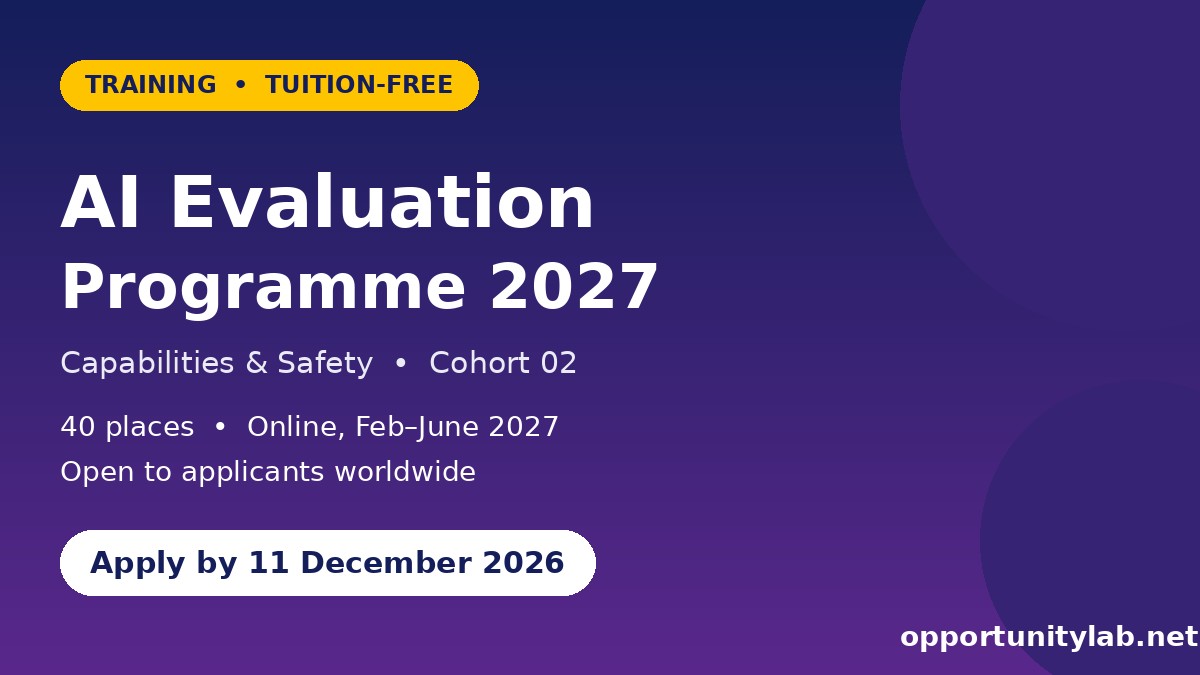
The International Programme on AI Evaluation: Capabilities and Safety is taking applications for its second cohort. The programme will pick 40 participants from around the world and cover their full tuition through a scholarship, so selected students, researchers and professionals can learn how to test what advanced AI systems can do and where they can go wrong.
The course runs online from 1 February to 25 June 2027. It is sponsored by the Valencian Graduate School and Research Network of Artificial Intelligence (ValgrAI) in Spain, funded by Coefficient Giving (formerly Open Philanthropy), and run with administrative support from the Berkeley Existential Risk Initiative (BERI). Africans with a background in AI, machine learning or AI policy can apply.
Deadline: 11 December 2026, 23:59 Anywhere on Earth (AoE). That is 12:59 on 12 December in Nigeria (WAT), 13:59 in South Africa (SAST/CAT) and 14:59 in Kenya (EAT).
Key Details
- Programme: International Programme on AI Evaluation: Capabilities and Safety, Cohort 02
- Format: Online, with live sessions on Tuesdays and Thursdays (Central European time). Organisers say they will try to set session times so that every participant can make at least one
- Duration: 1 February – 25 June 2027 (21 weeks)
- Time needed: 12–16 hours a week, including at least one live session a week
- Places: 40
- Cost: Tuition covered by a scholarship. There is no stipend
- Credential: ValgrAI Expert Diploma with a transcript
- Deadline: 11 December 2026 (AoE)
Benefits
- Fully covered tuition for a structured course on evaluating frontier AI systems
- Teaching from faculty at universities such as Cambridge, Stanford, Princeton, Oxford, MIT and Cornell. Last year, faculty also came from bodies such as the EU AI Office and the UK AI Safety Institute
- A mentored capstone: a real evaluation study done in a team of three or four, which you defend before a panel
- A ValgrAI Expert Diploma and transcript at the end
- A planned in-person capstone week in Valencia, Spain, in late May or early June 2027. Organisers say this depends on funding and the capstone will run online if it does not happen
- Access to a global network of AI evaluators, researchers and policy people
Note that the scholarship covers tuition only. There is no stipend, so plan for your own internet and power costs over the five months.
What the Programme Covers
The course mixes technical depth with policy and governance. Participants work through modules on evaluation methods, hands-on practice evaluating real models, and a team project that runs from March to June. The capstone counts for about a third of the final grade. In the first cohort, 40 participants from 18 countries took part, chosen from 673 applicants, according to the programme website.
Eligibility
- Open to applicants from anywhere in the world, including Africa
- Graduate or PhD students, early-career researchers, or professionals
- Expertise in AI and machine learning, through study or work
- Clear motivation to work on AI evaluation and safety, with a specific plan for where you want to have an impact
- Some technical literacy: for example, reading a research paper, understanding introductory statistics, calling a model through an API or running a notebook. This is not strictly required but helps a lot
- Able to commit 12–16 hours a week and attend at least one live session a week
- Good working English
How to Apply
- Read the programme details on the official AI Evaluation programme website.
- Go to the application page and request the application form.
- Prepare your CV and motivation statements, then submit the form before 11 December 2026 (AoE).
- Shortlisted applicants are invited to a 25-minute interview.
- Final decisions are expected on 15 January 2027, and offers must be accepted by 22 January 2027.
Tips
- Be specific in your motivation statement. The organisers want a concrete plan, for example joining an AI safety institute, building evaluation capacity in an African government agency, or doing a PhD in the field.
- Show your technical side with links to GitHub projects, papers or notebooks, even small ones.
- If you have a full-time job, check you can truly give 12–16 hours a week. The organisers advise against applying if you cannot.
- Live sessions are in Central European time, which is close to WAT, CAT and EAT, so most African applicants should find a workable slot.
- Apply early instead of waiting for the AoE cut-off, in case of power or internet problems.