Important: this is an in-person residency in Emeryville, California (USA). The Astera page does not say whether it sponsors US work visas, so non-US applicants should confirm this with Astera before investing heavily in a proposal.
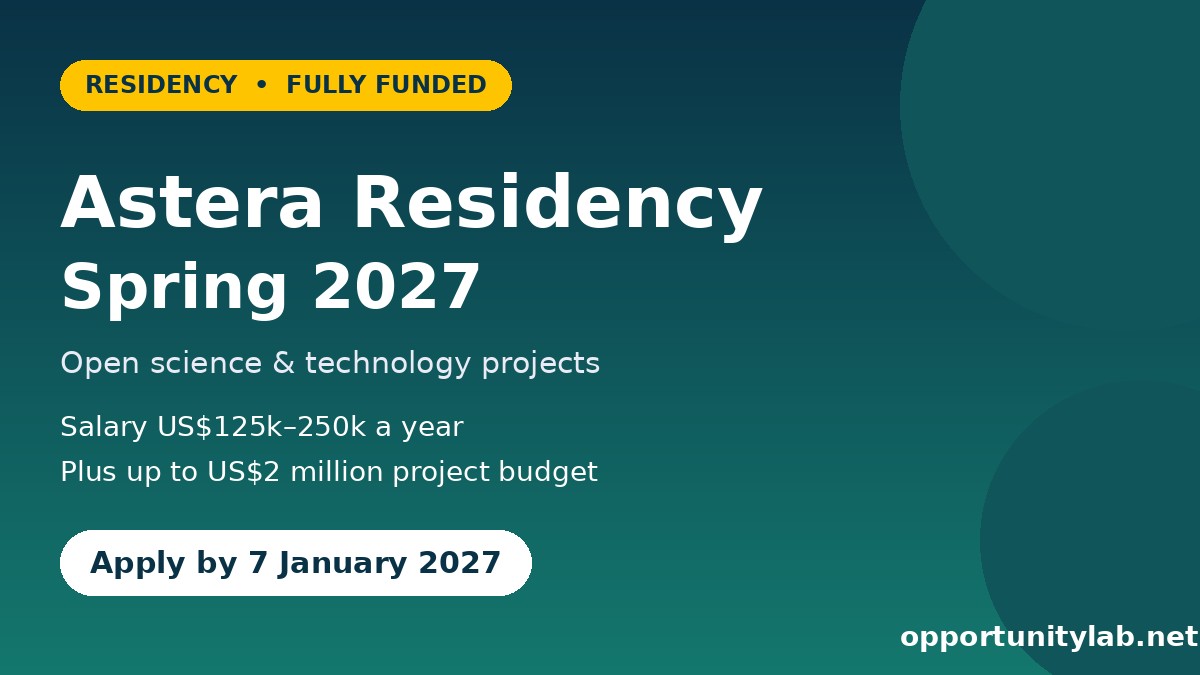
The Astera Institute has opened its Residency call for Spring 2027. The programme pays ambitious scientists, engineers and builders a salary of US$125,000–250,000 a year, plus a separately negotiated project budget of up to US$2 million, for 12 to 18 months to build open science and technology that traditional funders tend to skip.
Deadline: 7 January 2027. Astera does not give a time zone, so treat it as end of day US Pacific time at the latest (09:00 on 8 January WAT, 10:00 SAST/CAT, 11:00 EAT), and aim to submit a day early.
Key Details
- Funder: Astera Institute
- Programme: Astera Residency, Spring 2027 cohort
- Length: 12–18 months, fully funded
- Salary: US$125,000–250,000 a year, based on experience, plus benefits
- Project budget: Negotiated, from US$0 to US$2 million
- Location: Astera hub in Emeryville, California
- Deadline: 7 January 2027
Benefits
- A full salary and benefits for the length of the residency
- Money for project costs such as lab work, infrastructure, compute, software licences and staff
- Compute through Voltage Park, including on-demand access to 24,000 NVIDIA HGX H100 GPUs and reserved B200 and GB300 fleets
- A dedicated workspace at the Emeryville hub, with shared facilities and events
- A community of technologists working on hard problems in intelligence and the life sciences
Priority Areas for Spring 2027
Astera has named one wish from each of its science tracks this round, but says proposals outside this list are also welcome:
- Life Sciences: open, trustworthy benchmarks and evaluations for biological AI models
- Deep Tech: designs, tools and components for low-cost personal aviation
- Neuroscience: open tools that make voltage imaging of neurons more sensitive and scalable
- AI Research: brain-inspired models of intelligence, and AI used to understand the brain
- Open Science: research outputs designed for machine use, not only human readers
Astera expects work to be published openly under its Open Science Policy, although terms can be negotiated for projects with commercial potential. Projects can later become non-profits, companies or one-off public outputs.
Eligibility
- Entrepreneurial researchers, scientists, engineers and technologists with a concrete project idea
- Projects must create public goods, such as tools, infrastructure, standards, hardware, software or early-stage research
- Astera says it especially wants applicants from outside its usual networks
- Must be able to work in person in Emeryville, California. Check visa and work authorisation with Astera if you are not a US resident
- No nationality restriction is stated on the official page
How to Apply
- Read the full call on the Astera Residency page.
- Write a clear proposal: the problem, what you will build, why existing funders do not support it, and what you will deliver in 12–18 months.
- Submit through the official application form on Ashby before 7 January 2027.
- For questions, email [email protected].
Tips
- Astera says its residents have a theory of change they are testing with urgency. Show a working prototype, data or code if you have it.
- Ask about visa support early. A US visa process from Nigeria or elsewhere in Africa can take months.
- Tie your idea to one of the five priority areas if you can, but do not force it.
- Budget carefully. Explain what compute, lab or staff costs you need and why.
- African researchers working on open tools, for example datasets or benchmarks for African languages or health, can show how the work fills a real gap.