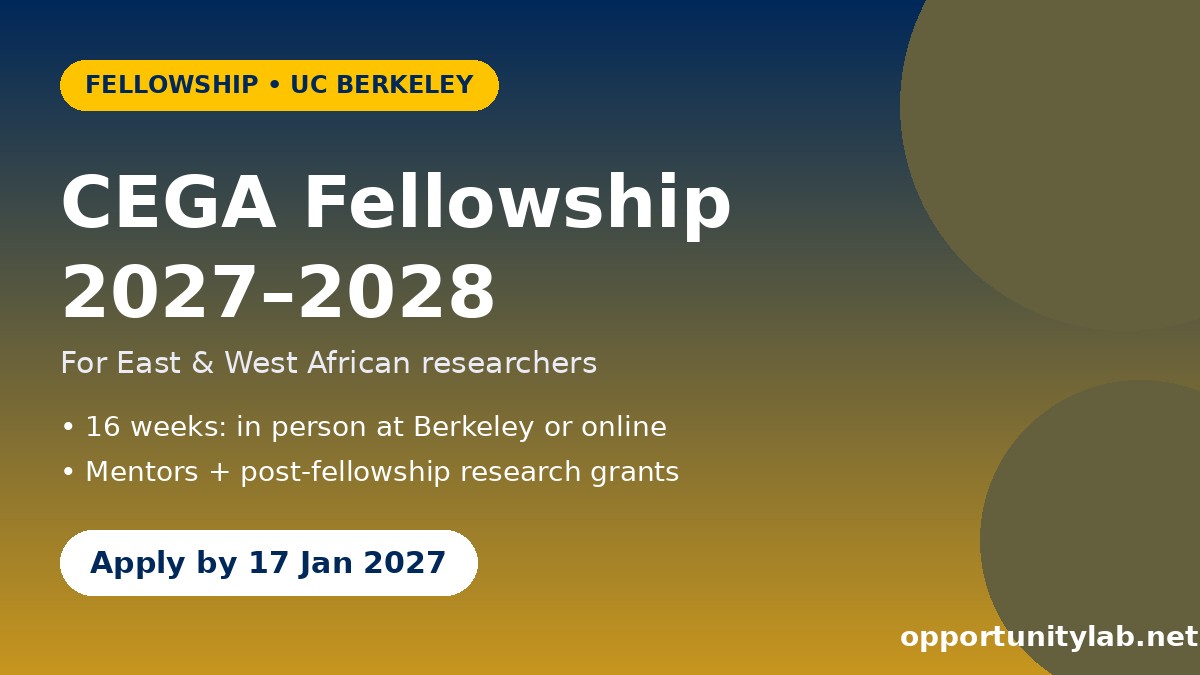
The Center for Effective Global Action (CEGA) at the University of California, Berkeley is accepting applications for its 2027–2028 Fellowship Program for researchers and practitioners from East and West Africa. The 16-week fellowship builds skills in quantitative development research and impact evaluation, with Berkeley coursework, a faculty mentor and a PhD peer partner, either in person at Berkeley or online.
Deadline: 17 January 2027, 5:00 p.m. GMT (6:00 p.m. WAT, 8:00 p.m. EAT).
Nigerians: because of current US visa restrictions, applicants from Nigeria (and some other countries) can join the online (Non-Resident) track, where they are given priority, but not the in-person track at Berkeley.
Key Details
- Host: Center for Effective Global Action (CEGA), UC Berkeley
- Length: 16 weeks; choose Fall 2027 (August–December) or Spring 2028 (January–May)
- Tracks: Academic Track or Practitioner Track
- Formats: Resident (at UC Berkeley) or Non-Resident (online)
- For: East and West African researchers and practitioners
- Deadline: 17 January 2027, 5:00 p.m. GMT
Benefits
- Resident Fellows: funded room and board, health insurance, visa fees, round-trip economy flights and a modest stipend
- Non-Resident Fellows: a modest stipend and online access to Berkeley-linked coursework (MicroMasters)
- tailored coursework in research methods and impact evaluation, a faculty mentor and a PhD peer partner
- after completing the fellowship: a funded Pilot Research Grant or a paid Professional Research Placement (practitioners are eligible for the placement only)
- eligibility for funding to train others at your home institution
- sponsorship to attend a CEGA Africa Evidence Summit
Which Countries Are Eligible
Resident (in person at Berkeley): applicants from countries eligible for a US J-1 visa: Djibouti, Ethiopia, Ghana, Guinea, Guinea-Bissau, Kenya, Liberia, Madagascar, Mauritius, Mozambique, Rwanda, Seychelles and Uganda (subject to change with US rules).
Non-Resident (online), with priority: Benin, Burkina Faso, Burundi, Côte d’Ivoire, The Gambia, Malawi, Mali, Mauritania, Niger, Nigeria, Senegal, Sierra Leone, Tanzania, Togo, Zambia and Zimbabwe.
Eligibility
- from an East or West African country, with at least secondary education completed in Africa
- at least a master’s degree, current PhD enrolment, or a PhD completed in the last 8 years
- field: economics, political science, statistics, epidemiology/public health or another social science
- fluent in written and spoken English
- plan to return to an institution in East or West Africa after the fellowship
- Practitioner Track: working at an NGO, think tank or government ministry in East or West Africa
- Academic Track: a doctoral student or staff member at a university or research institution
- able to commit full time (Resident, about 40 hours a week) or part time (Non-Resident, about 15–20 hours a week) for four months
Women are strongly encouraged to apply, and preference goes to applicants from the country or region where they plan to do research.
What to Submit
- a personal statement (max 1 page)
- a CV (max 2 pages)
- a policy statement (Practitioner Track) or research proposal (Academic Track), max 2 pages
- other items listed in the official call
How to Apply
- Read the full CEGA Fellowship 2027–2028 Request for Applications (PDF) and the CEGA announcement.
- Choose your track (Academic or Practitioner), format (Resident or Non-Resident) and semester.
- Submit through CEGA’s Submittable portal (linked in the call) by 17 January 2027, 5:00 p.m. GMT.
Key Dates
- Deadline: 17 January 2027
- Review: 18 January – 7 February 2027
- First interviews: 8–12 February 2027
- Final interviews: 22–26 February 2027
- Results: 1–12 March 2027
Tips
- Link your proposal to a real policy question in your country, such as health, education, social protection or agriculture.
- Show the quantitative skills you have and the ones you want to build.
- Secure your employer’s support early; you’ll need time off during the fellowship.
- Nigerian applicants: frame your plan around the online track and what you’ll achieve remotely.