
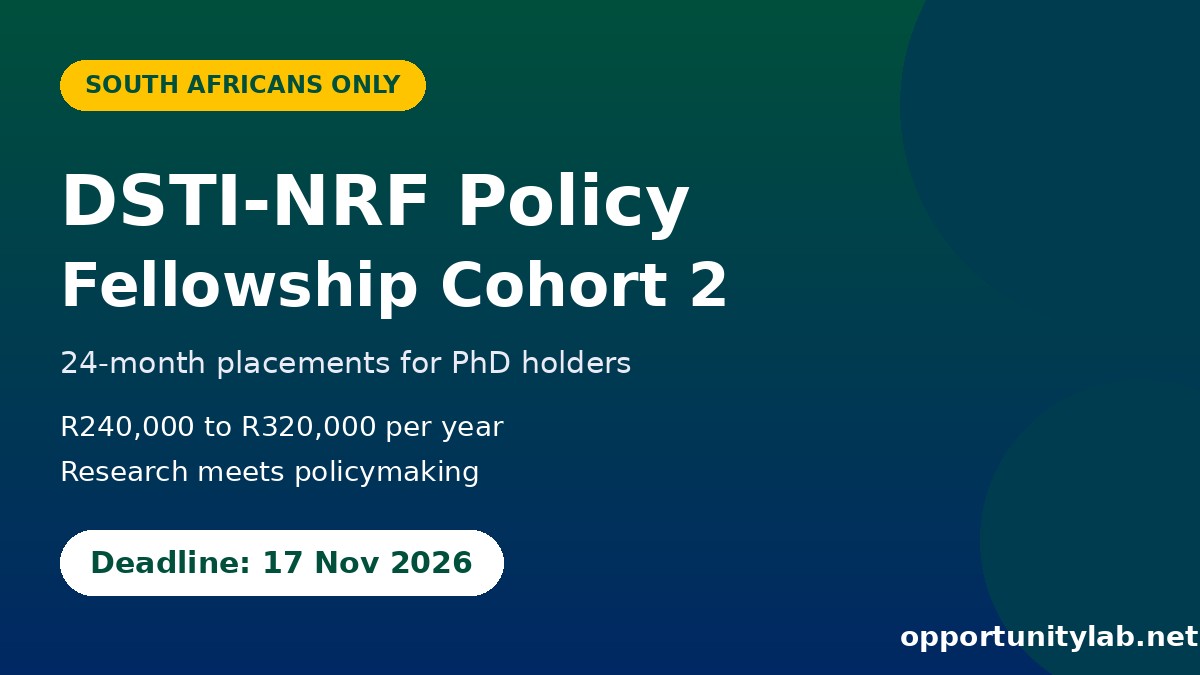
Important: this fellowship is mainly for South African citizens and permanent residents. Non-South Africans may be considered only in exceptional, well-justified cases and can make up no more than 10% of fellows.
South Africa’s National Research Foundation (NRF) and the Department of Science, Technology and Innovation (DSTI) are recruiting Cohort 2 of the DSTI–NRF Policy Fellowship Programme. Fellows with a doctorate are placed in a government or policy host institution for up to 24 months to help turn research evidence into policy, and receive R240,000 to R320,000 a year.
Closing date: 17 November 2026. The NRF page does not give a closing time, so submit as early as possible on or before that day. Late or incomplete applications will not be considered.
Key Details
- Organisers: National Research Foundation (NRF) and Department of Science, Technology and Innovation (DSTI)
- Cohort: 2 (building on a 2024 pilot)
- Duration: up to 24 months
- Value: R240,000–R320,000 per year
- Format: placement at a host institution plus an NRF-run policy engagement and training programme, with international exposure and networking
- Deadline: 17 November 2026
Benefits
- Annual fellowship funding of R240,000 to R320,000 for up to two years
- Practical experience in policy development, analysis and implementation inside a host institution
- Structured training and capacity building coordinated by the NRF
- Opportunities for international exposure and cross-sector networking
Thematic Areas
Science, technology and innovation policy; energy and climate; digital transformation and AI; urban development; health; agriculture and rural development; environment; social development and education; public administration; and international relations and science diplomacy.
Eligibility
- Early- and mid-career researchers who obtained a doctoral degree within the past 10 years
- South African citizens or permanent residents (non-South Africans only in exceptional cases, capped at 10%)
- Registered or employed (permanent or fixed-term) at an NRF-recognised research institution, such as a public university, science council, museum or national facility, or able to secure such an affiliation before the grant starts
- Able to attend the host institution regularly in person, so consider its location when choosing
How to Apply
- Read the call on the official NRF page and the programme framework (PDF, October 2026).
- Prepare PDFs of your ID or passport, proof of your doctorate and, if employed, a letter from your employer or institution supporting your participation and availability.
- Complete the DSTI–NRF Policy Fellowship online application form (linked from the NRF page), choose up to three host institutions and upload your documents before 17 November 2026.
Complete, eligible applications go through competitive merit review, which may include interviews with potential hosts. Questions go to [email protected].
Tips
- Read the framework before choosing hosts, and pick ones that match your research and that you can reach regularly.
- Get your employer’s support letter today; with a 17 November deadline, this is the document most likely to delay you.
- Show how your past research has, or could have, informed a real policy decision in South Africa.
- Non-South Africans should only apply with a strong justification, given the 10% cap.