
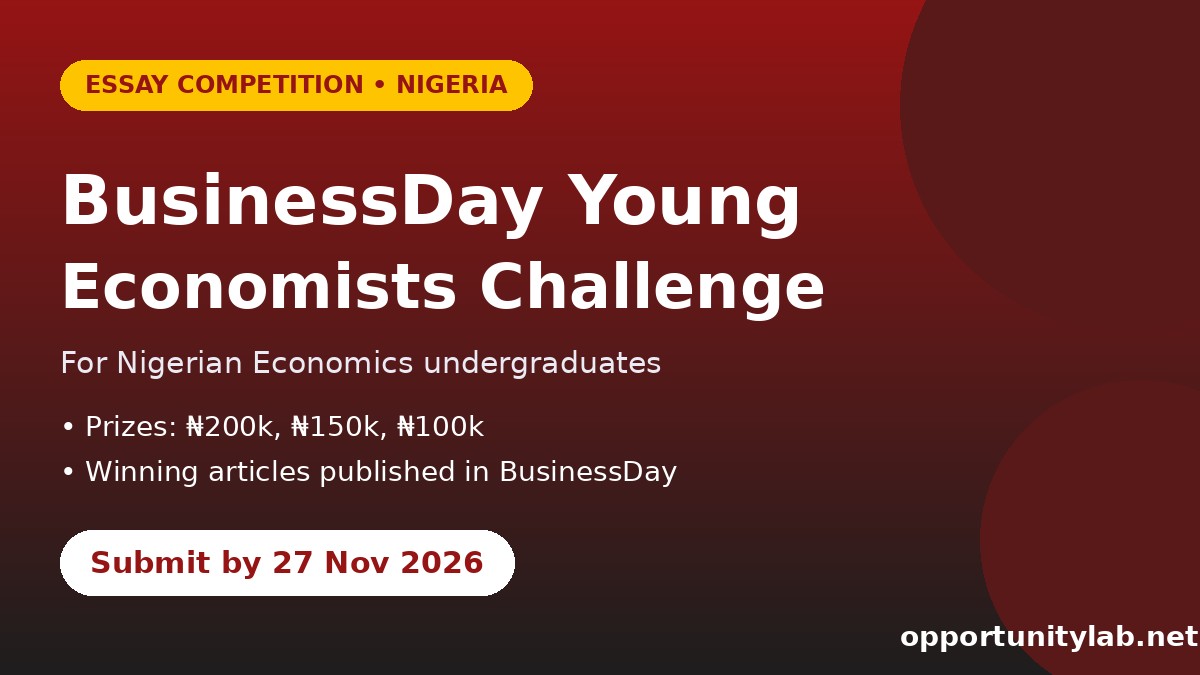


BusinessDay, the Lagos-based business newspaper, has opened entries for its 2027 Young Economists Writing Challenge for undergraduate Economics students in Nigerian universities. Write an original 800–1,000-word article on Nigeria’s economy and win up to ₦200,000, plus publication in BusinessDay.
Deadline: 27 November 2026. Winners will be announced on 5 January 2027.
Key Details
- Organiser: BusinessDay Nigeria
- For: undergraduate Economics students in recognised Nigerian universities
- Task: an original article of 800–1,000 words
- Total prizes: ₦450,000
- Entries open: 9 November 2026
- Deadline: 27 November 2026
- Winners announced: 5 January 2027
Benefits: Prizes
- 1st prize: ₦200,000
- 2nd prize: ₦150,000
- 3rd prize: ₦100,000
- winning articles published in BusinessDay
- a Certificate of Achievement, recognition at a BusinessDay event, and your photo in the newspaper
Choose One Topic
- What will it take for Nigeria to become a trillion-dollar economy?
- Inflation, jobs or economic growth: which should Nigeria prioritise?
- Detty December: can Nigeria turn its festive economy into a billion-dollar industry?
Eligibility
- an undergraduate student
- studying Economics
- at a recognised Nigerian university
- able to provide a valid student ID
How to Apply
- Write an original article of 800–1,000 words on one of the three topics.
- Submit through the BusinessDay writing challenge entry page or the QR code on BusinessDay’s official poster.
- Provide your full name, university, department and level, email address, phone number and a valid student ID.
- Submit before 27 November 2026; late entries won’t be accepted.
Details are from BusinessDay’s official announcement. If the entry page doesn’t load properly, use the QR code on BusinessDay’s poster or contact BusinessDay Conferences at [email protected].
Tips to Win
- Take a clear position in your first paragraph and defend it with data, such as NBS figures, CBN reports or World Bank numbers.
- Use simple, newspaper-style English: short paragraphs, no heavy jargon.
- Offer practical policy ideas, not just problems.
- Stay within 800–1,000 words and proofread carefully.
- Write originally; plagiarism or AI-copied work could get you disqualified.