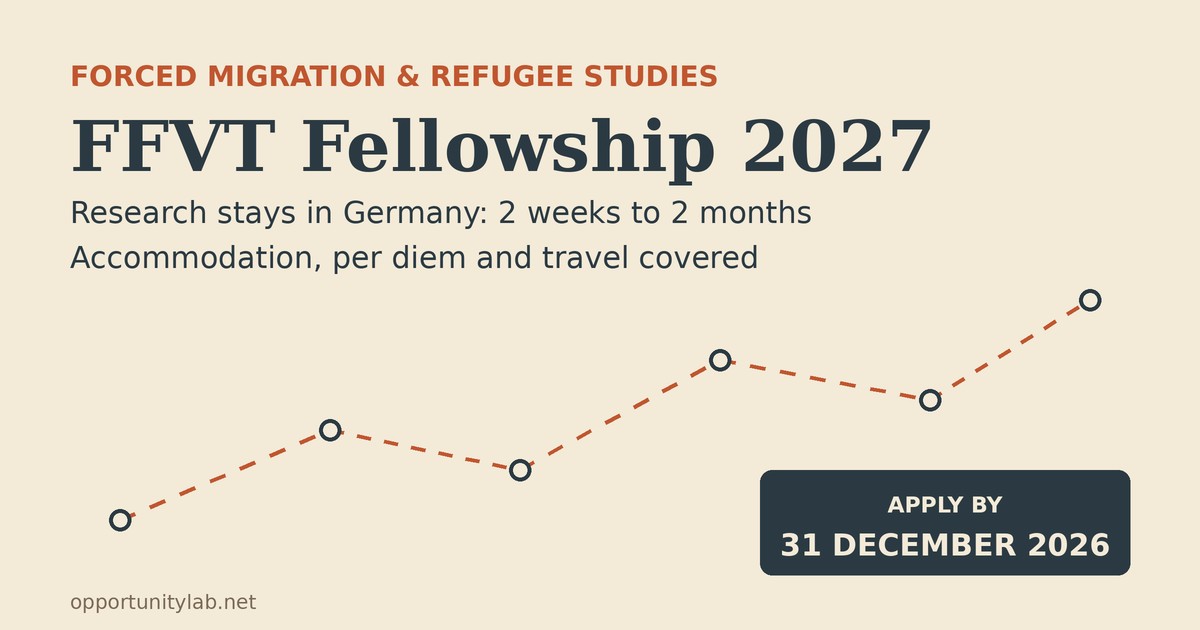

The FFVT Fellowship Programme is accepting applications for fellowship stays in Germany in 2027. It’s run by FFVT (“Forced Migration and Refugee Studies: Networking and Knowledge Transfer”), a German research network funded by the German Federal Ministry of Research, Technology and Space. Fellows spend two weeks to two months at a leading German research institute working on forced migration and refugees, with accommodation, a daily allowance and travel costs covered.
The programme is open to international researchers, including researchers from Africa. Applications close on 31 December 2026.
At a Glance
| Programme | FFVT Fellowship Programme 2027 |
| Run by | FFVT: bicc (Bonn International Centre for Conflict Studies), CHREN (Erlangen) and IMIS (Osnabrück University) |
| Host institutes | bicc in Bonn (up to two months) or IMIS in Osnabrück (two weeks) |
| Who can apply | International senior researchers, postdocs and doctoral candidates in forced migration and refugee studies |
| Funding | Accommodation, per diem and travel expenses |
| Deadline | 31 December 2026 |
About the Fellowship
FFVT aims to strengthen interdisciplinary research on forced migration in Germany and link it to related fields such as conflict, development, climate change, health, governance and human rights. The fellowship lets international researchers develop or carry out their own research or knowledge-transfer project together with a German host institute.
Possible topics include, but aren’t limited to:
- (Im)mobility and global standards of refugee protection
- Postcolonial perspectives and refugee voices
- Data production, representation and biases in forced migration research
- Research ethics and categorisations
- Global governance and externalisation
- Climate change and forced displacement
- The impacts and aftermath of the COVID-19 pandemic
Benefits
- A research stay of up to two months at bicc in Bonn or two weeks at IMIS in Osnabrück
- Accommodation, per diem and travel expenses covered
- On-site infrastructure and academic support from the host institute
- Exchange with FFVT teams and other researchers, plus participation in FFVT workshops, panels and summer schools
- The chance to visit other German research centres during your stay
- Membership of the FFVT alumni network and opportunities for joint proposals and publications
Eligibility
- You’re an international researcher working at an academic or practice-oriented institution in forced migration and refugee studies.
- Applications are welcome from senior researchers, postdoctoral researchers and doctoral candidates or junior researchers.
- Your project should fit FFVT’s aims or the research priorities of bicc or IMIS.
- Applications must be in English.
FFVT especially encourages applications that are relevant beyond the applicant’s own project, address fundamental questions in the field, or use reflexive and innovative methods.
How to Apply
- Prepare a motivation letter (2–4 pages): a brief description of your current project, your preferred period of stay plus an alternative, your choice of host institute (bicc or IMIS) with reasons, and your full contact details.
- Write a project outline (4–6 pages including references): the project you’ll develop or carry out during the stay, its relevance to FFVT, and a timeline.
- Add your academic CV with a list of key publications.
- Combine everything into one PDF and email it to [email protected] before 31 December 2026.
Official FFVT Call for Applications · FFVT announcement: Fellowship 2027
Tips for African Applicants
- Connect your project to displacement in your region, such as the Sahel, the Lake Chad Basin, the Horn of Africa, or climate-linked migration, and explain why German expertise helps.
- Choose your host carefully. bicc focuses on conflict and peace; IMIS on migration and intercultural studies. Say clearly why your choice fits.
- Plan your visa early. FFVT covers travel and living costs, but you’ll still need a German visa, so give yourself several months.
- Name concrete outputs, such as a lecture, a working paper or a joint proposal, as the call invites this.