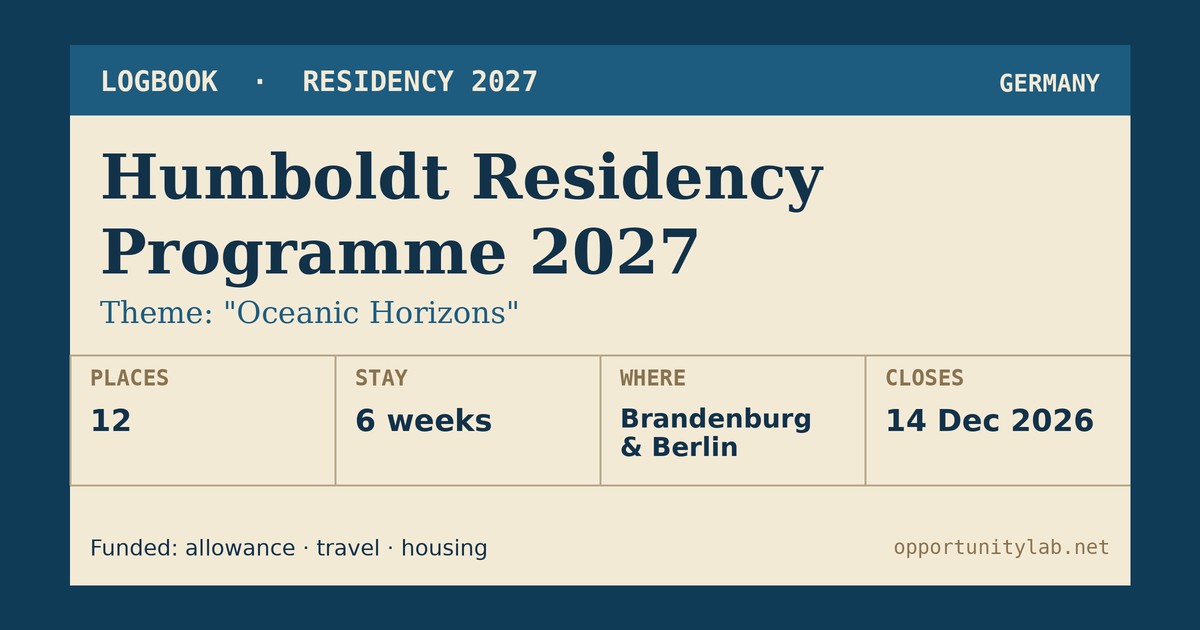
The Alexander von Humboldt Foundation in Germany is accepting applications for the Humboldt Residency Programme 2027. It’s a funded six-week residency in Brandenburg and Berlin that brings together 12 people from around the world, including researchers, writers, artists, journalists, NGO leaders and social entrepreneurs, to work together on one big theme.
The 2027 theme is “Oceanic Horizons: Navigating the Future of Our Blue Planet”. Applications close on 14 December 2026.
At a Glance
| Organiser | Alexander von Humboldt Foundation (Germany) |
| Theme | Oceanic Horizons: the future of our blue planet |
| Places | 12: 5 Humboldt alumni, 3 early-career researchers and 4 civil society practitioners |
| Residency | 2 August – 10 September 2027, in Brandenburg and Berlin (in person, mandatory) |
| Funding | Monthly allowance, travel to and from Germany, accommodation and a budget for public events |
| Deadline | 14 December 2026 (applications are reviewed on a rolling basis) |
Programme Timeline
- 29 June 2027: virtual kick-off meeting
- 2–13 August 2027: two weeks at the Cultural Foundation Schloss Wiepersdorf, Brandenburg
- 13 August – 10 September 2027: four weeks in Berlin, with trips to institutions in Northern Germany and the North Sea and Baltic Sea coasts
- September–October 2027: finishing your outputs remotely
- 26 October 2027: virtual wrap-up event
You must take part in person for the whole residency, from 2 August to 10 September 2027.
Benefits
- A monthly allowance during the six-week residency
- A travel allowance for your trip to and from Germany
- Accommodation at Schloss Wiepersdorf for 2 weeks and in a Berlin aparthotel for 4 weeks
- A budget for public events or other outputs, such as debates, workshops, media or publications
- Family accommodation and help arranging childcare if you travel with dependants
- Time, space and an international network to explore ocean issues across disciplines
The call doesn’t state the monthly allowance amount. Check the foundation’s FAQ document for details.
Eligibility
The programme is open internationally, including to Africans. There are three groups of participants:
1. Humboldt alumni (5 places)
- Previous Humboldt fellowship or award holders, not currently funded by another Humboldt programme in August 2027.
- Hold an academic position and are not based in Germany.
- Have expertise related to the theme and a willingness to communicate beyond academia.
2. Early-career researchers (3 places)
- Currently doing a PhD, or completed it less than four years before August 2027.
- Hold an academic position, are not based in Germany, and have a clear academic profile linked to the theme.
- Have some experience of science communication or of linking research to social and political issues.
3. Civil society practitioners (4 places)
- Creatives, such as journalists, authors, filmmakers, curators, artists or designers, or practitioners, such as people in politics, social entrepreneurs, campaigners, NGO staff or consultants.
- A clear link to ocean issues through previous work, and the potential to spread ideas widely.
- Do not currently hold an academic position.
People from all disciplines are welcome if they can show a real connection to the ocean theme.
How to Apply
- Prepare a CV of up to 3 pages, in PDF.
- Record a 60-second introduction video in landscape format (mp4, mov, avi or mpeg) explaining who you are and why you’re right for the programme. A good phone camera is fine.
- Upload the video to Smash (fromsmash.com) and copy the link.
- Complete the online application on the Humboldt Foundation’s site, add your CV and video link, and submit before 14 December 2026.
Applications are reviewed as they arrive, and decisions are due at the end of February 2027. There’s an online info session on 24 November 2026, 2:00–3:00pm CET. Questions can go to [email protected].
Official Humboldt Residency Programme 2027 call for applications
Tips for African Applicants
- Link your work to the ocean. Coastal livelihoods, fisheries, ports, blue economy startups, climate and sea-level rise, and marine conservation are all relevant to many African countries.
- Show how you communicate. The foundation wants people who can reach audiences beyond academia, so mention articles, films, campaigns, podcasts or community work.
- Make the video personal. Production quality isn’t judged, so focus on your story and ideas.
- Apply early. Applications are reviewed on a rolling basis.
- Plan for the visa. You’ll need a German (Schengen) visa for the full six weeks.