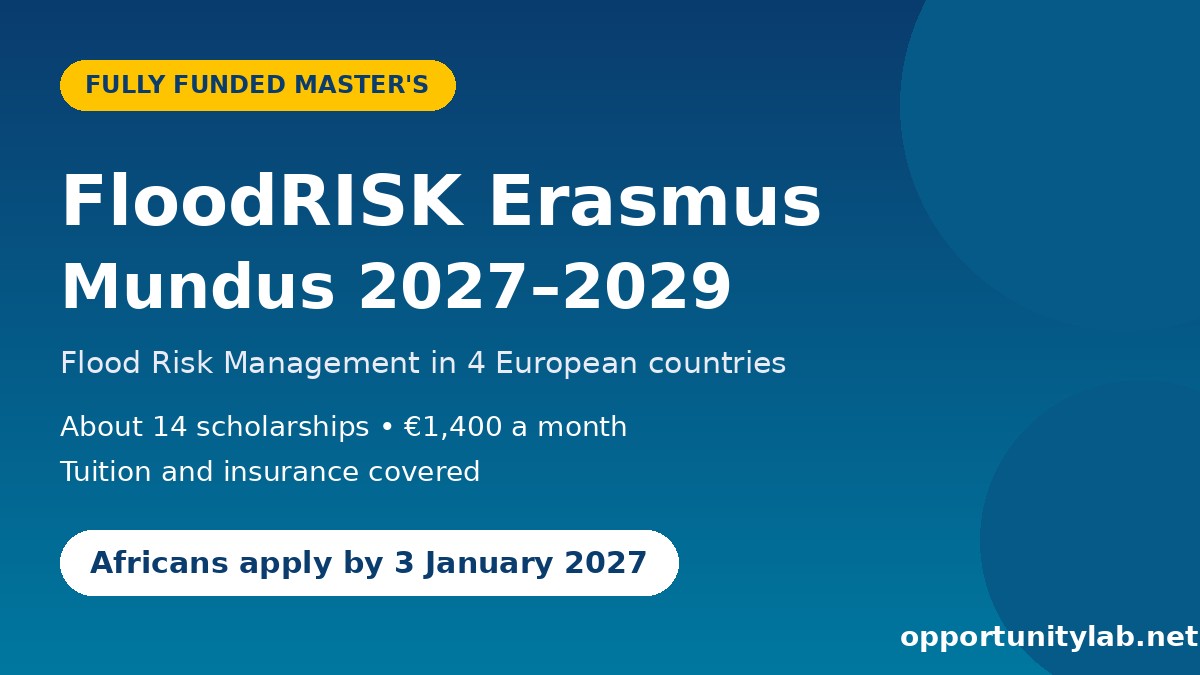
The Erasmus Mundus Joint Master in Flood Risk Management (FloodRISK) is offering around 14 fully funded Erasmus Mundus scholarships for the 2027–2029 intake. The two-year programme takes students through four European universities: TU Dresden (Germany), IHE Delft (Netherlands), the Technical University of Catalonia (UPC, Spain) and the University of Ljubljana (Slovenia).
Each scholarship covers tuition and all mandatory participation costs, full insurance and €1,400 a month for up to 24 months. Applicants from Nigeria and the rest of Africa count as “partner country” applicants and have the earliest deadline.
Scholarship deadline for non-European (partner country) applicants: 3 January 2027, 23:59 CET. That is 23:59 WAT (Nigeria) on 3 January, and 00:59 CAT/SAST and 01:59 EAT on 4 January.
Key Details
- Programme: Erasmus Mundus Joint Master in Flood Risk Management (two years, starting September 2027)
- Universities: TU Dresden, IHE Delft, UPC Barcelona and University of Ljubljana
- Scholarships: around 14 Erasmus Mundus scholarships for 2027–2029, plus a limited number of reduced-fee places
- Deadline (partner countries, including all African countries): 3 January 2027, 23:59 CET
- Deadline (European programme countries): 7 February 2027, 23:59 CET
- Reduced-fee scholarship deadline: 15 April 2027
- Results: early April 2027
- Application fee: none mentioned on the official site
Benefits
- Full tuition and participation costs, including library and laboratory costs and other mandatory fees (the normal fee is €18,000)
- Full insurance coverage
- €1,400 monthly allowance for the whole programme (up to 24 months), covering living costs, accommodation, travel and installation
- Study in four countries, with field trips to flood-prone areas, debris-flow and coastal flooding modules, and hydroinformatics modelling at IHE Delft
- A joint master’s degree recognised by the partner universities
- Extra support may be available for students with disabilities
Programme Structure
- Semester 1 – TU Dresden, Germany: foundation courses (engineering or non-engineering track) and a field trip
- Semester 2 – IHE Delft, Netherlands: hydroinformatics and modelling, with an international field trip
- Semester 3 – UPC Spain and University of Ljubljana, Slovenia: specialised modules, spatial planning and socio-economic frameworks
- Semester 4 – Research thesis: with one partner, sometimes together with an industry partner
Eligibility
- A bachelor’s degree (180 ECTS or equivalent) in civil or environmental engineering, geosciences, physical geography or a similar subject that included mathematics and water-related courses
- A good final grade: at least B/B+ (US system) or Second Class Upper (UK system)
- Final-year students can apply if they have at least 120 ECTS and will graduate by 15 August 2027
- Proof of English through an internationally recognised test. Some countries are exempt, but applicants from countries where English is the language of instruction still need a test unless their country is on IHE Delft’s exempted list, so check that list before assuming Nigeria qualifies.
- If your English test result is not ready by 3 January, you can upload it by 1 February 2027 and still be considered for a scholarship
- Previous Erasmus Mundus Joint Master scholarship holders follow EU rules that may exclude them
How to Apply
- Read the admission requirements and the scholarship page.
- Prepare certified copies of your degree certificate and transcripts (translated into English if needed), a CV, two recommendation letters (from lecturers or employers, ideally less than six months old) and your English test result.
- Draft answers to the five motivation questions shown on the how to apply page (600–1,000 characters each). Write them yourself: the programme says it deducts points for obvious AI writing.
- Complete the online form on the IHE Delft application portal and select Erasmus Mundus scholarship as your funding source.
- Submit before 3 January 2027, 23:59 CET. Files must be PDF, Word or JPEG, maximum 2 MB each.
- Questions go to [email protected].
Tips
- Link your motivation to real flood problems you know, such as the 2022 Nigerian floods, urban flooding in Lagos, or coastal erosion in the Niger Delta, and say what you will do about them after graduating.
- Book your IELTS or TOEFL test now. Test dates in December fill up quickly in Nigerian cities.
- Get your transcripts certified early. University registries often close over the Christmas break.
- Ask referees who can describe a specific project you did, such as a hydrology lab, a drainage design or GIS flood mapping.
- Do not wait for the last day: the portal can be slow close to the deadline.