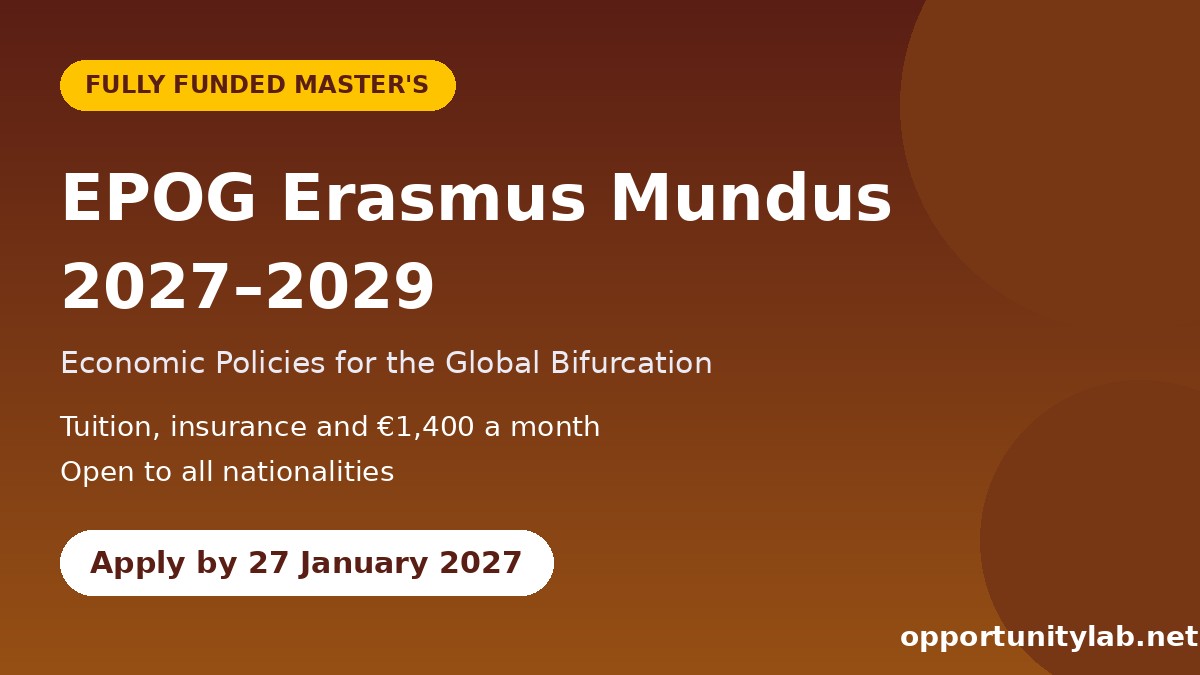
Applications are open for the EPOG-JM Erasmus Mundus Joint Master (Economic Policies for the Global Bifurcation), a two-year master’s in economics and policy for the 2027–2029 cohort. It focuses on innovation and the digital economy, macroeconomics and finance, and sustainable development. Some scholarship sites list it under the name “GLOBAL COOP”.
The Erasmus Mundus scholarship covers tuition fees, health and accident insurance, and €1,400 a month for both academic years. EPOG states that all applicants, wherever they come from, are eligible if they meet the academic requirements, so Nigerians and other Africans can apply. One online form covers both admission and the scholarship.
Deadline: 27 January 2027, 13:00 Paris time. That is 13:00 WAT (Nigeria), 14:00 CAT/SAST and 15:00 EAT.
Key Details
- Programme: EPOG-JM, Erasmus Mundus Joint Master in Economic Policies for the Global Bifurcation (two years)
- Majors: A – Innovation, the digital economy and the sociotechnical bifurcation; B – Macroeconomics, finance and the socioeconomic bifurcation; C – Sustainable development and the socioecological bifurcation
- Scholarship: tuition, insurance and €1,400 a month for two years
- Deadline: 27 January 2027, 13:00 Paris time
- Interviews: March 2027 (applicants must be available)
- Results: end of March 2027
- Contact: [email protected]
Benefits
- Tuition fees covered, including health and accident insurance that meets European Commission minimum requirements
- €1,400 monthly allowance during both academic years
- Compulsory study in more than one country, with host institutions that depend on your chosen Major and Minor
- Students not selected for an Erasmus Mundus scholarship can ask for conditional admission while they seek other funding, such as Eiffel or DAAD scholarships, which EPOG mentions on its site
- Extra support is available for students with disabilities
Eligibility
- A bachelor’s or equivalent degree of 180 ECTS
- A good level of English (specific conditions apply to some Minors)
- A clear motivation for the programme
- Requirements differ slightly by Major and Minor, for example in how much economics and statistics you have studied, so read the conditions for your chosen pathway on the admission page.
- Anyone who has previously held an Erasmus Mundus Joint Master scholarship is not eligible
- No more than 10% of scholarship holders can share the same nationality
How to Apply
- Study the Majors and Minors on the EPOG admission page and decide your preference order. Courses, degrees and host countries depend on it.
- Prepare a full CV, scanned diploma(s), transcripts, proof of English, a statement of purpose, a scanned passport and two recommendation letters.
- Fill in the EPOG online application form and upload all documents in the Attachments section. Do not email them.
- Submit before 27 January 2027, 13:00 Paris time.
- Keep March 2027 free for possible interviews.
- Read the scholarships page for the full award rules.
Tips
- Start early with your recommendation letters. EPOG warns that getting them takes time.
- In your statement of purpose, connect your interest to a real African policy issue, such as Nigeria’s energy transition, inflation and exchange-rate policy, or digital financial inclusion, and explain why your chosen Major fits.
- Show quantitative skills: list econometrics or statistics courses, Stata, R or Python, and any research assistant work.
- If your degree was taught in English, check on the admission page whether a sworn statement or university letter can serve as language proof.
- Apply for other scholarships in parallel, as the programme itself suggests.