

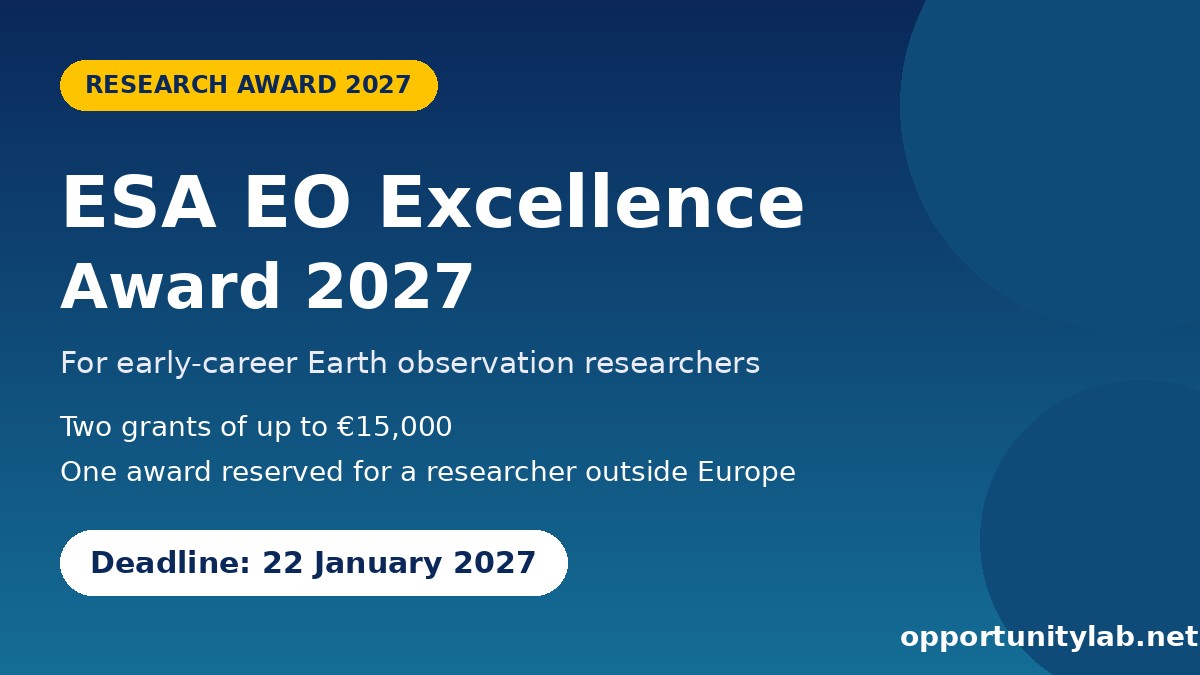
The European Space Agency (ESA) has opened self-nominations for the EO Excellence Award 2027, the sixth edition of its prize for early-career researchers who use Earth observation (EO) satellite data in science and applications. Two winners will each receive an ESA research grant of up to €15,000, and one of the two awards is reserved for a researcher from a country outside Europe, which gives African scientists a dedicated route to win.
Deadline: 22 January 2027 at 23:59 UTC (00:59 WAT, 01:59 CAT/SAST and 02:59 EAT on 23 January 2027).
Key Details
- Organiser: European Space Agency (ESA), with the award run by AZO
- Award: two research grants of up to €15,000 each
- Split: one winner from an ESA Member State and one winner from a country outside Europe
- Who: early-career researchers using EO satellite data
- Application type: self-nomination with a peer recommendation letter
- Nomination window: 20 October 2026 to 22 January 2027 (23:59 UTC)
- Evaluation: January to March 2027; winners announced in April 2027
- Cost to apply: free
Benefits of the EO Excellence Award
- A grant of up to €15,000 to advance the research for which the award is given
- An ESA staff supervisor who follows and supports the funded activities
- Funds can be used for things such as travel, research visits, networking, workshops and the purchase of Earth observation data, according to the award terms
- International visibility through ESA and the award’s Hall of Fame, which has featured past winners from leading European research institutions
After the winners are announced, each awardee submits a short proposal (maximum two pages) explaining how the money will be used. The proposal must link to at least one of ESA’s Earth Observation Science Strategy themes. The final amount depends on the scope of the activities, up to the €15,000 ceiling.
Research Themes
Applicants pick one or more of ESA’s science themes that best fit their project: the water cycle; the carbon cycle and chemistry; energy fluxes; ecosystem health; extremes and hazards; and interfaces and coupling in the Earth system. Work on floods, drought, coastal change, land degradation, crop monitoring, air quality or urban heat in Africa can fit well under these themes.
Eligibility
- You are an early-career researcher: within five years of your highest degree (MSc or PhD) and no more than ten years since your first degree (BSc), excluding periods of maternity leave.
- Your work focuses on the scientific or applied use of Earth observation satellite data. Projects that mainly develop new EO technology or engineering are not eligible.
- You have a record of publications in specialised journals and enough research experience.
- You have a signed one-page recommendation letter from a peer scientist in your field.
- Not eligible: current ESA staff or contractors (and those who left less than a year ago), Selection Committee members and previous winners. Check the full exclusion list in the terms and conditions.
The non-European award is open to researchers from countries outside Europe, so applicants from Nigeria and the rest of Africa can compete for it. ESA notes that selection of this winner is subject to the award’s eligibility criteria and terms.
How to Apply
- Read the eligibility rules and the terms and conditions (PDF).
- Download the recommendation letter and project description templates from the official nominee page.
- Ask a peer scientist to sign a one-page recommendation letter explaining why you deserve the award.
- Prepare your CV, a selected bibliography and your project description.
- Complete the online self-nomination form and upload your documents before 22 January 2027, 23:59 UTC.
- For questions, email [email protected] or visit the EO Excellence Award website.
Tips for African Applicants
- Show clear impact: explain how your satellite-based work helps people, for example early flood warning, food security, water management or climate adaptation in your country.
- Name the satellite missions and datasets you use (such as Copernicus Sentinel data) and explain what is new about your method.
- Keep your bibliography focused on your strongest peer-reviewed papers instead of listing everything.
- Ask your referee early, as December and January are busy months in universities.
- Submit a few days before the deadline; the form closes at 23:59 UTC, which is already 23 January in Nigeria, South Africa and Kenya.