Important: you must be under 26 on 16 October 2026 and must never have applied to the ENS International Selection before.
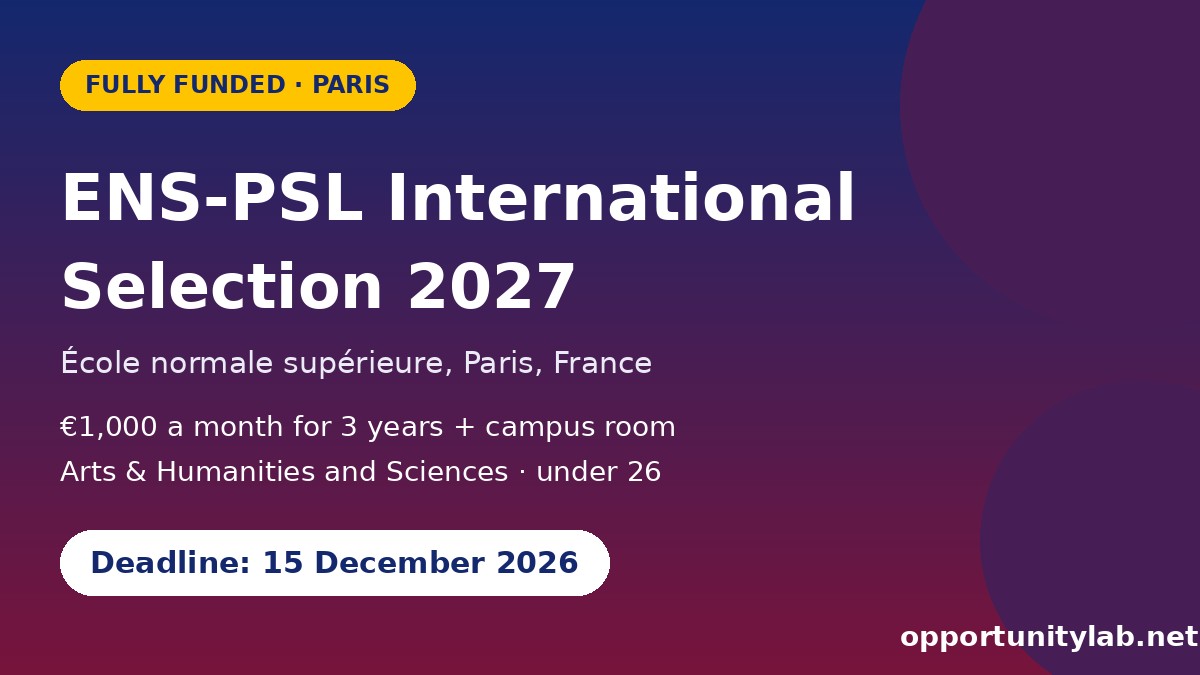
The École normale supérieure – PSL (ENS-PSL) in Paris, one of France’s most selective schools, has opened its 2027 International Selection in Arts and Humanities and in Sciences. Students admitted through this competition study for three years at ENS-PSL, finishing with a master’s degree and the ENS diploma, and receive a grant of €1,000 a month for 36 months plus a room on an ENS-PSL campus. Tuition in French public universities is paid by the state; students pay only registration fees.
Deadline: 15 December 2026 at 2:00 pm Paris time (2:00 pm WAT, 3:00 pm CAT/SAST and 4:00 pm EAT).
Key Details
- Institution: École normale supérieure – PSL, Paris, France
- Entry level: third year of bachelor’s (licence 3) or first year of master’s (master 1)
- Duration: three years, leading to a master’s degree and the ENS diploma
- Tracks: Arts and Humanities; Sciences
- Applications: 16 October to 15 December 2026 (2:00 pm Paris time) on the OnePSL30 platform
- Selection rate: between 5% and 10%, according to ENS
- Shortlist results: from 21 January 2027 (Arts and Humanities) and from 27 January 2027 (Sciences)
- Remote tests: 15–26 February 2027 (Arts and Humanities) and 3–19 March 2027 (Sciences)
Benefits
- €1,000 a month for 36 months, paid into a French bank account
- A room on an ENS-PSL campus in Paris (rue d’Ulm in the first year; Ulm, Jourdan or Montrouge after that, allocated by students)
- No tuition fees, as these are covered by the French state (registration fees apply)
- A master’s degree plus the prestigious ENS diploma
- Intensive French classes at the start, and French lessons throughout the year
- A welcome programme with conferences, department visits and cultural visits of Paris
Disciplines
Arts and Humanities candidates can choose from anthropology, archaeology, classics (Greek and Latin), cinema, theatre studies, history of art, musicology, cognitive sciences, economics, political studies, geography, history, history and philosophy of law, history and philosophy of science, linguistics, literature, philosophy and sociology. The Sciences track covers the scientific departments of ENS-PSL; check the official page for the current list.
Eligibility
Arts and Humanities:
- Aged 25 or younger when applications open (you must not have turned 26).
- At least three years of study toward a foreign university degree (you can apply while in your third year).
- You have not lived in France for more than 10 months during the competition year or the year before.
- Good French: about B1 level to follow courses and tests (no official certificate required). The motivation letter and research project must be in French, except in economics, linguistics and cognitive studies.
Sciences:
- Under 26 on the day applications opened.
- At least one year of undergraduate study at a foreign university when applying, and at least two years by the time you enrol.
- Not registered at a French school or university for more than six months in total during the competition year and the year before.
- No official language level is required; teaching is in French or English depending on the department.
In both tracks you may apply only once.
How to Apply
- Read the official International Selection page and the FAQ.
- Prepare your CV, high school diploma and full university transcripts.
- Arts and Humanities: write a motivation letter (1–3 pages) and a research project (up to 10,000 characters) with a 10-book bibliography. Sciences: write a cover letter (1–3 pages) in French or English presenting your study plan.
- Enter 2 to 4 referees’ email addresses on the platform so they can upload recommendation letters. Do not use @icloud.com addresses.
- Submit everything on the OnePSL30 application platform before 2:00 pm Paris time on 15 December 2026. Email applications are not accepted.
Tips
- Start with your referees today; three weeks is short, especially with end-of-year exams in Nigerian and other African universities.
- For Arts and Humanities, treat the research project like a mini proposal: a clear question, hypotheses, sources and real academic references.
- If your French is weak, the Sciences track or the English-option disciplines may suit you better.
- Plan for the remote tests in February and March: secure a quiet room and stable internet or a backup connection.
- If admitted, apply quickly for a French long-stay student visa through Campus France in your country.