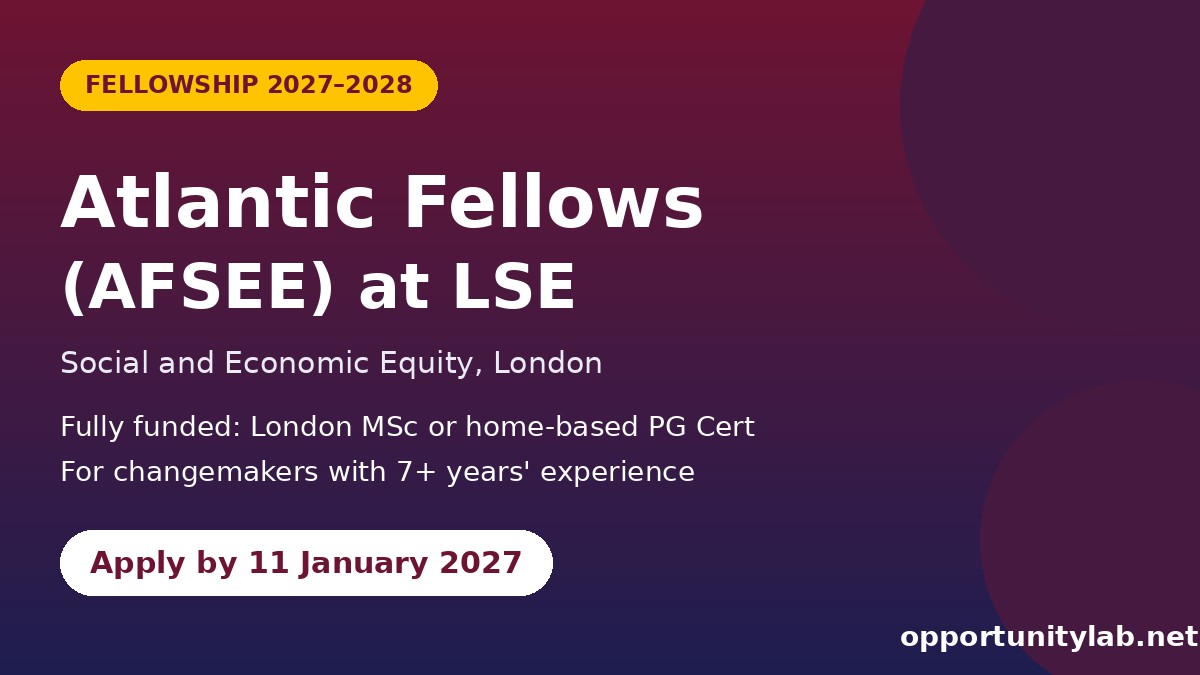
Applications are open for the 2027–28 cohort of the Atlantic Fellows for Social and Economic Equity (AFSEE), a funded, lifelong fellowship based at the International Inequalities Institute of the London School of Economics and Political Science (LSE). It is for mid-career social-change leaders with at least seven years of experience challenging inequality, and LSE says most of its fellows come from the Global South.
Deadline: 11 January 2027 at 5:00 pm UK time (6:00 pm WAT, 7:00 pm CAT/SAST and 8:00 pm EAT). Late applications will not be accepted.
Key Details
- Host: International Inequalities Institute, LSE, London
- Cohort: 2027–28 (the programme’s eleventh cohort)
- Tracks: Residential (one year in London, studying the MSc in Inequalities and Social Science) and Non-Residential (stay in your home country and run a practice-based project)
- Who: policymakers, researchers, activists, practitioners, artists and movement builders with 7+ years of experience
- Application: online through LSE’s Graduate Application System, with two references
- Timeline: interview invitations mid-March 2027; final decisions mid-April 2027; cohort announced mid-July 2027
Benefits
- Residential track: LSE’s fellowship funding page (most recently published for the 2025–26 cycle) lists full tuition fees plus a £23,000 stipend, with up to nine residential awards a year. AFSEE’s earlier information booklet also lists travel to and from London and visa costs.
- Non-Residential track: fellows earn a Postgraduate Certificate in Social and Economic Equity. AFSEE’s earlier booklet lists certificate fees, travel, accommodation and visa costs for the in-person modules, plus up to £10,000 towards the fellow’s project.
- Four fellowship modules with academics, campaigners and civil society experts, covering inequality, policy for equity and social change
- Lifelong Senior Fellowship after the active year, with access to funding, joint projects and the global Atlantic Fellows network, supported by the Atlantic Institute in Oxford
Note: LSE describes AFSEE as fully funded, but the amounts above come from LSE and AFSEE materials for earlier cohorts. Confirm the 2027–28 figures with the programme team before you make plans.
Eligibility
- At least seven years of experience in work that challenges social or economic inequality, in any field (for example economic and social rights, environmental justice, tax justice, women’s, minority and disability rights, education, housing, labour rights, community organising, arts and peacebuilding).
- Ability to meet LSE’s English language requirements. You do not need to take an English test before submitting your application.
- Residential applicants must also qualify for admission to the MSc in Inequalities and Social Science.
- Open to applicants from all countries; an undergraduate degree is not strictly required, but you must upload transcripts or a document explaining that you do not hold one.
How to Apply
- Read the official AFSEE How to Apply page and the LSE announcement for the 2027–28 cohort.
- Choose the Residential or Non-Residential track and read the statement of academic purpose guidance for that track.
- Nominate two referees early and make sure both references arrive by the reference deadline.
- Prepare your CV, transcripts (or a note that you have no degree) and your statement of academic purpose.
- Submit through LSE’s Graduate Application System before 5:00 pm UK time on 11 January 2027. Questions can go to [email protected].
Tips
- Show your track record with evidence: campaigns you led, policies you changed, communities you reached and the results.
- Explain clearly what you want to learn at LSE and how it will change your work back home in Nigeria or elsewhere in Africa.
- Request transcripts now. Many universities close for the Christmas and New Year break, and incomplete applications are not considered.
- Pick referees who have seen your work closely, not only well-known names.
- Join the weekly drop-in Zoom sessions the programme runs in November and December to ask questions.