Eligibility note: This first round of the Tor Community Fellowship is only open to applicants from or based in 21 listed countries. In Africa, these are the Democratic Republic of the Congo, Ethiopia, Kenya, Liberia, Mozambique, Rwanda, Somalia, Sudan, Tanzania, Uganda, Zambia and Zimbabwe. Nigeria, Ghana and South Africa are not on the list. If your country is not eligible, see the related opportunities open to Africans at the end of this article.
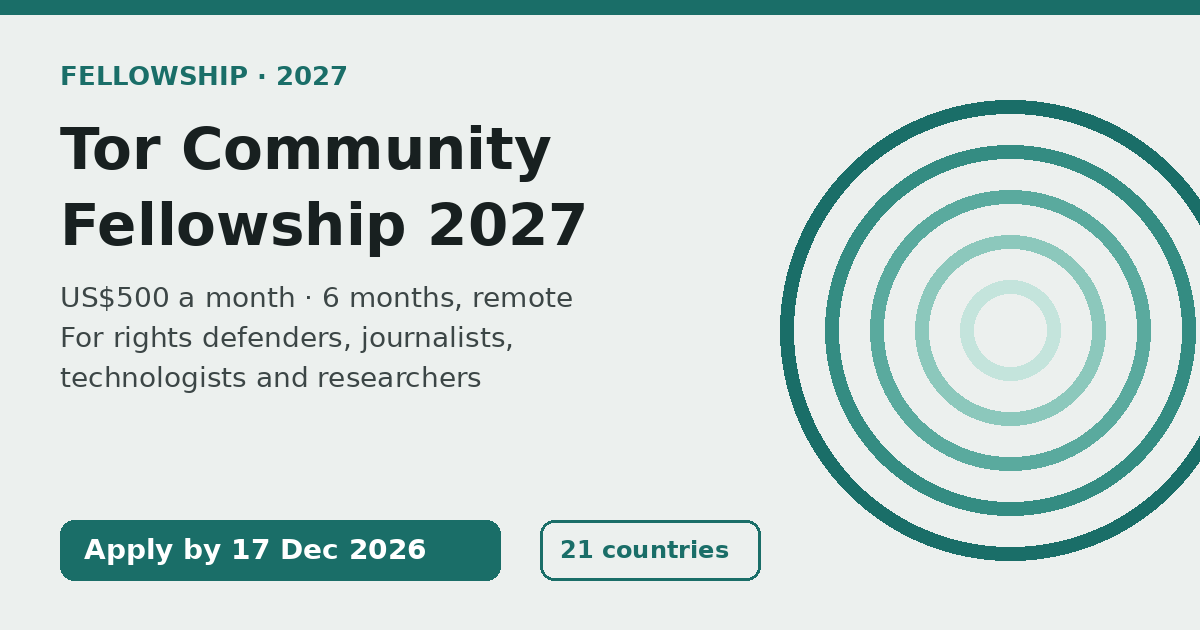
The Tor Project, the US nonprofit behind Tor Browser, has launched the Tor Community Fellowship 2027. In its first year, the fellowship will select 4 human rights defenders, journalists, technologists and researchers to learn from the Tor Project team about internet censorship, censorship circumvention and technical investigations involving Tor.
The part-time, remote fellowship runs for six months, from February to July 2027, and pays a stipend of US$500 a month. Applications close on 17 December 2026.
Key Facts
- Organiser: The Tor Project, Inc.
- Places: 4 fellows
- Duration: 6 months, February – July 2027 (part-time, remote)
- Time commitment: About 10–12 hours a month
- Stipend: US$500 a month
- Deadline: 17 December 2026
Eligibility
According to the Tor Project’s official call, applicants should:
- Be a human rights defender, journalist, technologist or researcher.
- Be from or based in one of the eligible countries:
- Africa: Democratic Republic of the Congo, Ethiopia, Kenya, Liberia, Mozambique, Rwanda, Somalia, Sudan, Tanzania, Uganda, Zambia, Zimbabwe
- Asia: Bangladesh
- Europe: Russia, Ukraine
- Latin America: Bolivia, Colombia, Cuba, Guatemala
- Middle East and North Africa: Palestine, Syria
- Show past engagement in digital rights and security work, such as advocacy, investigations or training.
- Understand the digital threats, including censorship and surveillance, faced by journalists, human rights defenders and civil society in their local context.
- Be familiar with Tor-powered apps such as Tor Browser, Tails and Orbot, and understand basics like IP addresses and DNS.
- Be interested in developing a small project on a digital rights or security topic, such as censorship circumvention, anonymity or privacy.
- Be able to work in English and have a computer and a stable internet connection for video calls.
The Tor Project notes that, because of US sanctions, it cannot transfer funds directly to individuals based in Cuba or Russia.
Benefits
- US$500 monthly stipend for the six months of the fellowship.
- Training from the Tor Project team on how internet censorship works and how Tor supports circumvention at the network level.
- Technical investigation skills related to Tor.
- A small project on a related topic of your choice to close the fellowship.
- A peer cohort and discussion groups with the Tor Project.
How to Apply
- Check that you are from or based in one of the eligible countries listed above.
- Read the official call for applications on the Tor Project Forum.
- Complete the official application form before 17 December 2026.
- For questions, contact the organiser through the email address given in the official call.
Stay Safe
The Tor Project does not charge an application fee. Apply only through the official Tor Project links above, and be wary of anyone asking for money or passwords in the fellowship’s name.
How We Checked This
All details come from the Tor Project’s official call for applications, posted on the Tor Project Forum on 17 November 2026.
Related Opportunities Open to Africans
- Digispace Africa Research Fellowship 2027: Free Virtual Fellowship on Digital Rights and Policy
- Knight Science Journalism Fellowship for Africa and the Middle East 2027–28
- EJN Story Grants 2027 for Journalists in Ghana, DRC, Uganda and South Africa
- Dataphyte Infra-Watch Media Fellowship 2027 for Nigerian Journalists