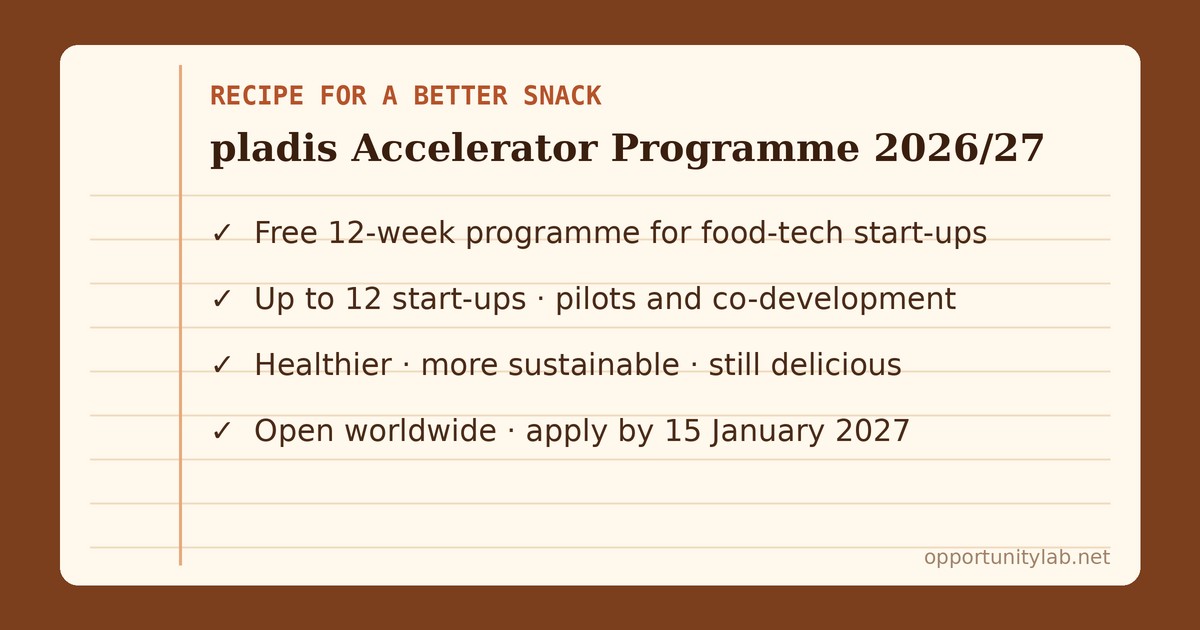
pladis, the global snacking company that is part of Yıldız Holding, has opened applications for the second round of its pladis Accelerator Programme (2026/27). It’s looking for food-tech start-ups with technologies that make snacks healthier, more sustainable or more affordable without making them less enjoyable. Selected start-ups work with pladis specialists for 12 weeks, and some go on to paid pilots or co-development.
The programme is free and open to start-ups worldwide. The first round drew about 300 applications from five continents. Applications close on 15 January 2027.
At a Glance
| Organiser | pladis, with Forward Fooding (start-up sourcing) and Yıldız Ventures (ecosystem partner) |
| Who can apply | Food-tech start-ups worldwide |
| Places | Up to 12 start-ups; 3–6 may move on to pilots or co-development |
| Format | 12-week collaboration with pladis specialists |
| Cost | Free |
| Deadline | 15 January 2027 (selected start-ups announced in early March) |
What pladis Is Looking For
- Reformulation that keeps snacks indulgent while improving nutrition, for example reducing sugar
- Flavour and texture technologies, including fermentation, enzymatic processing and sensory science
- Natural alternatives to common additives
- Gut health, functional ingredients and personalised nutrition
- Ingredient and process technologies that make snack production more sustainable and resilient
Past finalists include an enzyme that converts sugar into fibre after it’s eaten, a fermentation technology that turns food by-products into a cocoa alternative, and an AI platform for finding plant-based bioactive ingredients.
Benefits
- Free 12-week programme with technical and operational experts from pladis
- Mentorship from pladis and Yıldız Holding teams. The first round had 37 mentors.
- A route to proof-of-concept pilots or co-development with a global snacking company
- Exposure to a large food manufacturer and its supply chain
Eligibility
- You must be a start-up with a food, process or ingredient technology relevant to snacking.
- Your technology should improve nutrition, sustainability or affordability without hurting taste or texture.
- Start-ups from any country can apply, including in Africa.
- Don’t share confidential information. The application form asks you not to submit anything that isn’t already public or that is financial.
How to Apply
- Prepare a short summary of your technology, its stage and how it could work in snack products.
- Open the official application form (link below). It takes about 3 minutes and must be completed in one sitting, because progress isn’t saved.
- Answer the questions, which are mostly multiple choice with optional space to expand.
- Submit by 15 January 2027.
Official 2026/27 pladis Accelerator application form
Note: pladis’s own programme page (pladisglobal.com) may still show last year’s details. The current dates (3 November 2026 – 15 January 2027) come from pladis’s announcement of the second round, as reported in the trade press, and the official form is titled “26/27 pladis Accelerator programme”.
Tips
- Show evidence: lab results, sensory tests or pilot data make your technology more credible.
- Link your solution to real products, such as biscuits, chocolate or cake, and explain how it fits into large-scale manufacturing.
- African food-tech founders: technologies using local crops, by-products or fermentation may stand out on sustainability.