
Important: only companies registered in Ethiopia, Kenya, Malawi, Mozambique, Namibia, Rwanda, Tanzania, Uganda, South Africa or Zambia can lead an application, and they must partner with a company in the European Union. Nigerian, Ghanaian and other West African firms are not eligible to lead, and individuals cannot apply.
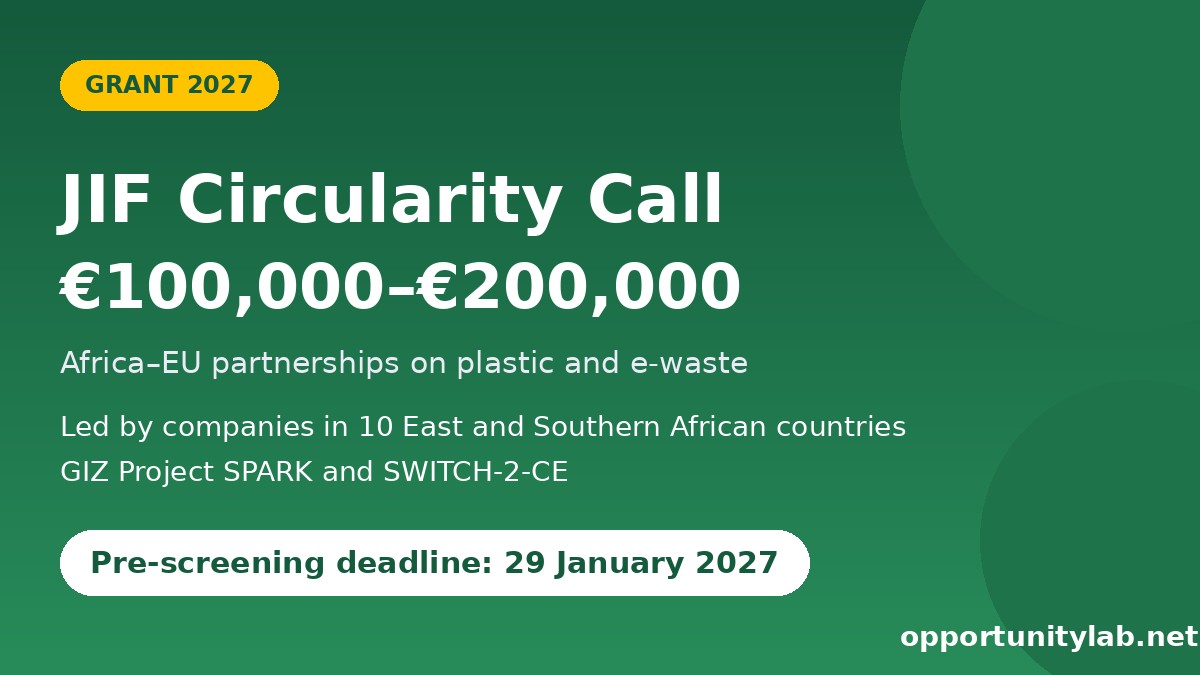
The Joint Innovation Facility (JIF) Circularity Call offers €100,000 to €200,000 in non-dilutive, milestone-based grants to Africa–EU business partnerships working on plastic packaging and plastic waste, or electronics and e-waste. The call is run by GIZ’s Project SPARK and the SWITCH-2-CE in East and Southern Africa programme, which is co-funded by the European Union and Germany’s development ministry (BMZ) and implemented with Expertise France.
Pre-screening deadline: 29 January 2027 (no time zone given on the official page). Applicants who pass pre-screening must submit a full grant proposal by 28 February 2027. Pre-screening applications are reviewed on a rolling basis, so early applicants have more time.
Key Details
- Funders and implementers: GIZ (Project SPARK and SWITCH-2-CE in ESA), with Expertise France, on behalf of the EU and BMZ
- Grant size: €100,000–€200,000, non-dilutive and milestone-based
- Value chains: plastic packaging and plastic waste; electronics and e-waste
- Applicants: consortia of two or three partners led by an African for-profit company
- Call opened: 2 November 2026
- Pre-screening deadline: 29 January 2027
- Full proposal deadline: 28 February 2027 (invited applicants only)
- Platform: Good Grants
Benefits
- €100,000–€200,000 grant to introduce or scale circular business activities in Sub-Saharan Africa and the EU.
- Technical assistance to strengthen business models, investment readiness and scaling potential.
- Ecosystem connections with investors, innovation hubs, accelerators, corporates and research networks in Africa and Europe.
- Support for long-term Africa–EU partnerships that continue after the grant period.
What Projects Can Cover
- Circular design and production: better product and process design, lower resource use and more recycled materials.
- Circular use: models that extend product life through reuse, repair, refurbishment or sharing.
- Value recovery: recovering materials and components from products and waste and returning them to use.
- Circularity enablers: digital, technological, business or financial tools that strengthen circular value chains.
The call welcomes upstream, midstream and downstream solutions but has a particular interest in upstream and midstream approaches.
Eligibility
- Lead partner: an African for-profit company registered in Ethiopia, Kenya, Malawi, Mozambique, Namibia, Rwanda, Tanzania, Uganda, South Africa or Zambia, with at least three years in operation.
- Second partner: a for-profit company registered in one of the 27 EU member states (start-ups, SMEs or larger companies).
- Optional third partner: an applied research organisation, non-profit, public sector body, or another for-profit company from the EU or Africa.
- The business must already have a commercially viable model, demonstrated revenue and potential for regional growth.
- Partners must commit their own resources and share a long-term commercial vision.
- Gender responsiveness is prioritised.
How to Apply
- Read the eligibility criteria and FAQs on the official JIF Circularity Call page.
- Agree a partnership with an EU-based company (and, if useful, a third partner).
- Submit a short project summary and pre-screening answers on the JIF Good Grants platform by 29 January 2027. A commercial viability check of your operations, finances, governance and compliance follows.
- If you pass, submit the full grant proposal by 28 February 2027.
- Join one of the free online information sessions (3 December 2026, 10 December 2026 or 19 January 2027) listed on the official page. Questions can go to [email protected].
Tips
- Start looking for an EU partner now; finding the right company is usually the slowest part.
- Bring clear revenue figures and audited or management accounts, since pre-screening tests commercial viability.
- Show how you will measure circular impact, for example tonnes of plastic recovered or devices refurbished each year.
- Explain what each partner brings: for example, the EU company’s technology and your local collection network.
- Submit before January; reviews are rolling, and a passed applicant needs at least two weeks for the full proposal.