

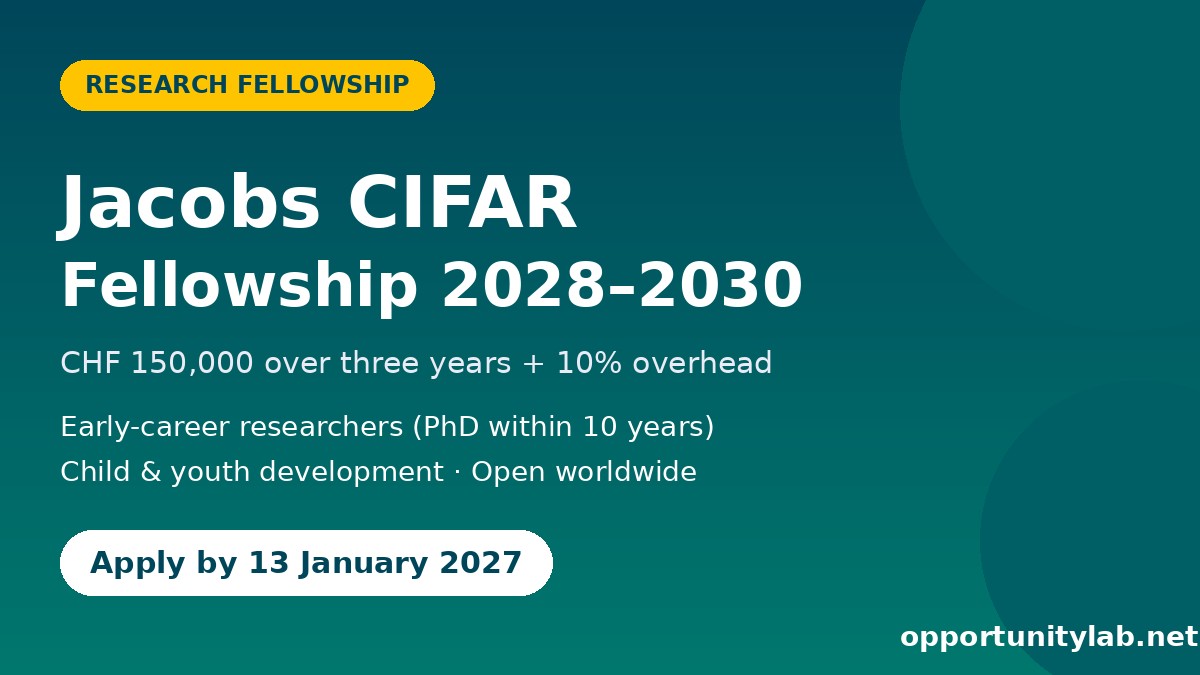
The Jacobs Foundation and the Canadian Institute for Advanced Research (CIFAR) are accepting applications for the 2028–2030 Jacobs CIFAR Research Fellowship. Each fellow receives a three-year grant of CHF 150,000 (about CAD 260,250), plus up to 10% for overhead, bringing the total to CHF 165,000.
The fellowship is for early-career researchers who earned a PhD within the last 10 years and who study child and youth development and learning. It is open to researchers from any country, so faculty at African universities can apply. Up to 12 fellowships are given each year.
Important: postdoctoral fellows are not eligible. You must hold a full-time academic or research post (tenure-track or equivalent) at a university or research institute.
Deadline: 13 January 2027 at 12:00 noon EST (18:00 WAT in Nigeria, 19:00 CAT/SAST and 20:00 EAT).
Key Details
- Funders: Jacobs Foundation and CIFAR
- Grant: CHF 150,000 over three years, plus up to 10% overhead (total CHF 165,000, paid in Canadian dollars)
- Fellowship period: 1 January 2028 to 31 December 2031 (fixed dates)
- Number of awards: up to 12 a year
- Who: researchers with a PhD obtained in or after November 2016 (adjusted for leave)
- Where: fellows stay at their own institution anywhere in the world
- Deadline: 13 January 2027, 12:00 noon EST
- Award decisions: by the end of August 2027
Benefits
- CHF 150,000 unrestricted research grant paid to your host institution over three years
- Up to 50% of the grant can cover part of your own salary
- The rest can pay for research staff, equipment, technical help and professional travel
- An extra 10% for overhead or indirect costs
- Membership of the Jacobs CIFAR Research Fellowship network, with mentors and researchers across disciplines and countries
- Chances to start new international and interdisciplinary collaborations
- Funds move with you if you change institutions during the fellowship
Research Focus
The fellowship supports discovery and pre-clinical research on what shapes children’s education and development and why children learn differently (learning variability). Topics include physical and mental health, growth and development, built and natural environments, and changing contexts. Proposals that combine several disciplines, methods or levels of analysis are especially welcome. Applicants should link their work to the Jacobs Foundation’s Strategy 2030 and learning agenda.
Eligibility
- PhD or equivalent obtained in or after November 2016 (periods of parental leave, sick leave or similar can extend this window)
- If you have not finished your PhD yet, you must complete it before awards are made at the end of August 2027
- Employed full time at a university or research institution (non-profit and for-profit organisations do not qualify)
- Tenure-track post where that system exists; elsewhere, a post with similar independence and a path to a permanent faculty position
- Postdoctoral fellows cannot apply
- Research closely tied to early education, child and youth development, and learning variability
- Individual applications only; joint applications are not allowed
- Open to researchers of any nationality based anywhere in the world
How to Apply
- Read the Jacobs Foundation announcement and the full call, programme guide and FAQ on the CIFAR application portal.
- Register or log in on the CIFAR portal (SurveyMonkey Apply).
- Complete the initial round: a short description of your research plan and how it fits interdisciplinary work on early education and learning variability. No CV or reference letter is needed at this stage.
- Agree to take part in distributed peer review: every applicant reviews 5–7 other applications. Poor or missing reviews can disqualify your own application.
- Submit before 13 January 2027, 12:00 noon EST.
- If invited, submit an extended proposal with a budget, timeline, narrative CV and one recommendation letter, then attend an interview.
Tips
- Ask your university’s research office early: the money is paid to the institution, so you will need their support and banking details later.
- Show why your context matters. Research on learning in Nigerian, Ghanaian or Kenyan classrooms can add something new to a mostly Global North field.
- Explain how you will work with researchers in other disciplines; this is a key selection point.
- Take the peer-review task seriously and write short, clear reasons for each score.
- Send questions to [email protected] well before the deadline.