
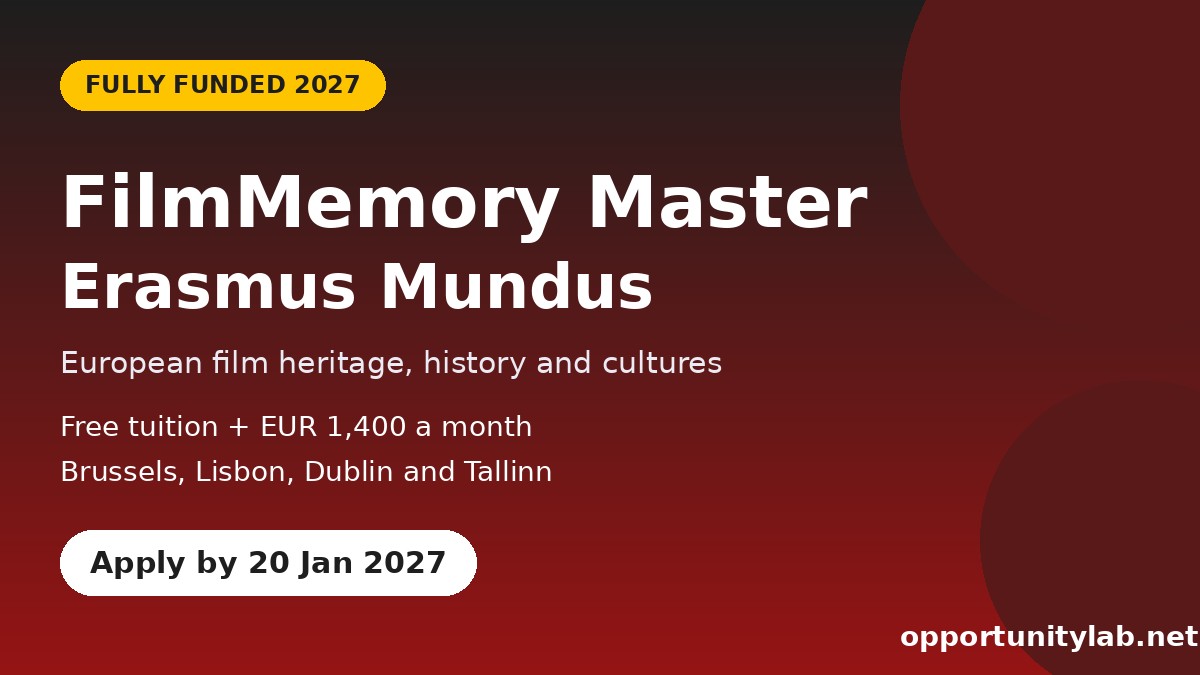

Film, media, history and heritage graduates can apply for fully funded Erasmus Mundus scholarships for FilmMemory: European Film Heritage, History and Cultures 2027–2029, a two-year joint master’s that trains specialists and filmmakers to work creatively and critically with audiovisual archives and film heritage. The programme is delivered by four art schools: LUCA School of Arts (Belgium), Universidade Lusófona (Portugal), IADT (Ireland) and Tallinn University’s Baltic Film, Media and Arts School (Estonia).
Scholarship holders pay no tuition and receive €1,400 a month for up to 24 months. Applicants from anywhere in the world, including Nigeria and other African countries, can apply. Deadline: 20 January 2027 at 23:59 CET, which is 23:59 WAT on 20 January, and 00:59 CAT/SAST and 01:59 EAT on 21 January.
Key Details
- Programme: FilmMemory Erasmus Mundus Joint Master (EMJM)
- Study route: Semester 1 Brussels, Semester 2 Lisbon, Semester 3 Dublin, Semester 4 Tallinn or one of the other partner cities
- Places: Up to 24 students per intake; some receive Erasmus+ scholarships
- Self-funded tuition: €10,000 for four semesters (as reported by the programme)
- Deadline: 20 January 2027, 23:59 CET
- Online interviews: 9–12 March 2027 for the top 50 applicants
Scholarship Benefits
- No tuition fees for scholarship holders.
- €1,400 per month for up to 24 months, contributing to travel, visa and living costs.
- Study in four European capitals and work with film archives, festivals and heritage institutions.
- A joint master’s degree that opens careers in film curation, archiving, restoration, festival programming, research and documentary filmmaking.
Eligibility
- A bachelor’s degree (EQF level 6) in audiovisual arts, film studies, communication, arts, history, cultural studies or a related field such as archival studies, heritage studies or museology. Other degrees may be considered with a strong application.
- You must graduate by 31 August 2027; final-year students can apply with an enrolment statement.
- English at CEFR B2, for example IELTS Academic 6.5 (no section below 5.5), TOEFL iBT 79, Duolingo 110 or Cambridge 170+, taken on or after 20 January 2022. A degree taught in English in the UK, Ireland, the US, Canada, Australia or New Zealand is also accepted, but a “medium of instruction” letter from other universities is not.
How to Apply
- Read the official call for applicants and the tuition fees and scholarships page.
- Prepare: diplomas and transcripts, English certificate, passport (ideally valid to at least 31 August 2027) and a recent high-definition photo on a white background.
- Record a one-minute selfie-style motivation video in English (unlisted link, no password).
- Write a preliminary graduation project proposal of up to 500 words.
- Complete one selection assignment: a 500-word critical essay, a critical video essay of up to 8 minutes, or a film-based data analytics project.
- Submit everything through the FilmMemory application form before 20 January 2027 (23:59 CET). An optional portfolio PDF can be added.
Tips for African Applicants
- Use your proposal to spotlight African film heritage, for example Nollywood’s VHS era, colonial newsreels, or the restoration of early Ghanaian or Senegalese cinema.
- The video essay option is a great way to show both critical thinking and editing skills.
- Nigerian degrees are not on the English-exemption list, so book IELTS, TOEFL or Duolingo early.
- No more than 10% of Erasmus Mundus awards usually go to one nationality, so make your application stand out with a specific, well-researched idea.