
Important: this call funds incubators and accelerators only. If you want to start a single nonprofit or social enterprise yourself, this is not the right route; Coefficient Giving points would-be founders to incubator programmes such as AIM’s Charity Entrepreneurship instead.
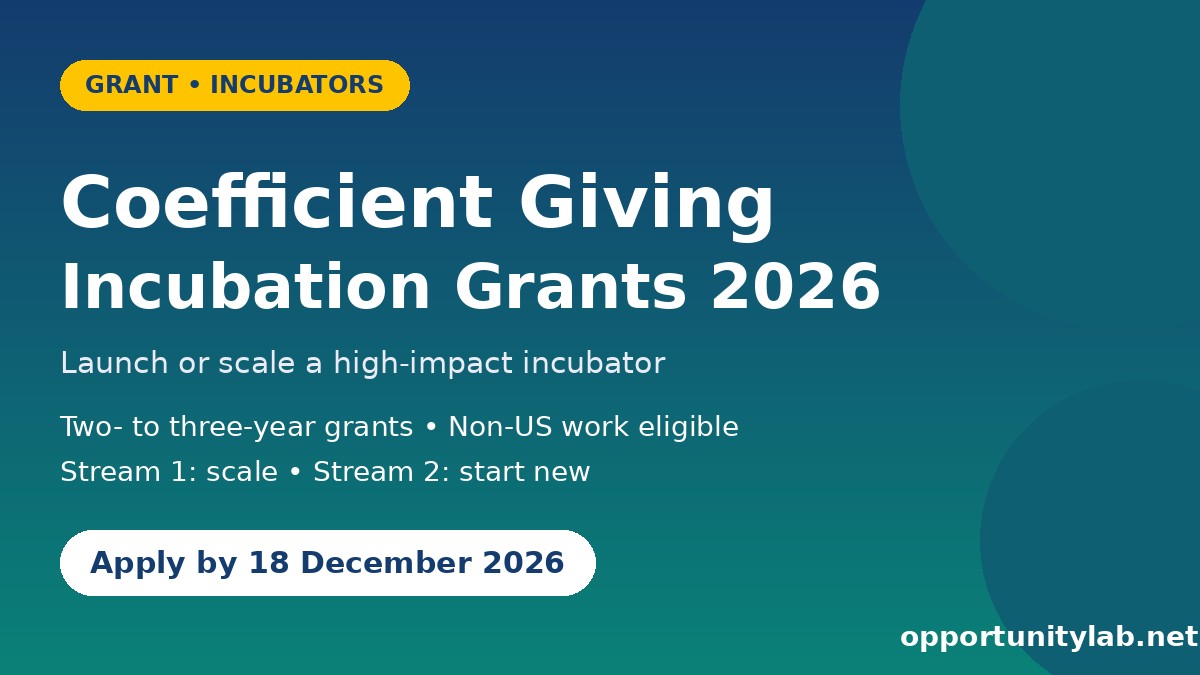
Coefficient Giving, the philanthropic funder formerly known as Open Philanthropy, has opened a Request for Proposals (RFP) for impact-oriented incubators. It wants to scale existing incubators and accelerators and seed at least one brand-new incubator, most likely through two- to three-year grants. Past incubation grants from the funder have ranged from US$20,000 to US$7.5 million.
The funder says it is especially interested in new incubators in countries where many high-impact organisations could operate but few incubators exist, and it prefers such incubators to be headquartered locally and staffed mainly by local people. That makes this call highly relevant to experienced African nonprofit founders, venture builders and fellowship operators.
Deadline: Friday, 18 December 2026, 11:59 pm Pacific Time (Saturday, 19 December 2026 at 8:59 am WAT, 9:59 am CAT/SAST and 10:59 am EAT).
Key Details
- Funder: Coefficient Giving (Effective Giving & Careers programme)
- Type: Organisational grant for incubators, accelerators, venture studios and similar programmes
- Stream 1: Scaling existing incubators that have already launched organisations
- Stream 2: Seeding new incubators started by individuals or teams
- Grant size: No fixed amount; past incubation grants ranged from US$20,000 to US$7.5 million
- Grant length: Most grants expected to last two to three years
- Stage 1 application: Short form, about two to three hours
- Deadline: 18 December 2026, 11:59 pm PT (19 December, 8:59 am WAT)
- Decisions: Assessment January–March 2027; grant decisions expected by end of April 2027
Benefits of the Coefficient Giving Incubation Grant
- Multi-year funding (typically two to three years) to build or grow an incubator
- For new incubators: funding for the core team, initial research, founder recruitment, programme delivery and, if needed, seed grants for the first cohort
- For existing incubators: funding for additional or dedicated cohorts, core functions such as research and founder recruitment, post-launch support and pass-through seed grants to newly launched organisations
- Budgets may include costs such as fiscal sponsorship fees and legal costs
- The chance to work on a list of specific organisations that Coefficient Giving’s programme teams would like to see exist
- With your permission, your application may be shared with other funders who might want to support your work
What Kinds of Organisations Should the Incubator Launch?
Organisations incubated under this grant should work in areas that match Coefficient Giving’s priorities, including global health and wellbeing, global aid policy, economic growth, scientific progress, farm animal welfare and reducing global catastrophic risks. The funder publishes a list of organisation ideas from its programme teams, such as think-and-do tanks pushing for more cost-effective aid, but applicants are free to propose their own ideas if they can explain why they are high priority. Cost-effectiveness is the top consideration.
Eligibility
- Any organisation or team that launches, or plans to launch, new high-impact organisations, including nonprofits, venture studios, fellowships, accelerators and individuals or teams
- Work outside the United States is eligible; the funder says it is especially interested in certain non-US geographies
- You do not need a legal entity at the time of application, but a new incubator will need an entity or fiscal sponsor able to receive funds before a grant is made
- For-profit organisations may apply, subject to due diligence
- Stream 2 applicants should ideally have founded or run a high-impact organisation, know the geography or cause area well and be able to commit full-time for several years
- Individuals wanting to start a single organisation (not an incubator) are not eligible
How to Apply
- Read the full call on the official Coefficient Giving RFP page, including the list of organisations its programme teams want to see incubated and the FAQ.
- Decide which stream fits you: Stream 1 (scaling an existing incubator) or Stream 2 (starting a new one).
- Prepare your answers: what you do or plan to do, how you choose ideas, 3–5 specific organisations you would launch, how you will find and select founders, your core team’s CVs or LinkedIn profiles and a rough budget (duration, amount, what it pays for, other funders and number of organisations to be launched).
- Stream 1 applicants should add their track record in numbers; Stream 2 applicants should explain their current stage and why the incubator needs to exist (about 150 words).
- Submit the Stage 1 application form before 18 December 2026, 11:59 pm PT. Shortlisted applicants will be invited to submit a full proposal and may be interviewed.
Tips for African Applicants
- Make the local case clearly: show why your country or region has many unmet high-impact opportunities and few incubators, and why your team is based there.
- Use concrete numbers. The funder says honest estimates and uncertainty are more useful than polished prose, and it screens out applications that appear largely AI-generated.
- If you are not yet incorporated, decide early between registering a new entity (for example with the CAC in Nigeria) and using a fiscal sponsor, and include the related costs in your budget.
- Check whether your country has rules on receiving foreign contributions; the funder says this can lengthen disbursement and it will work with you to meet such requirements.
- Questions will not be answered after 10 December, so read the FAQ well before the deadline.