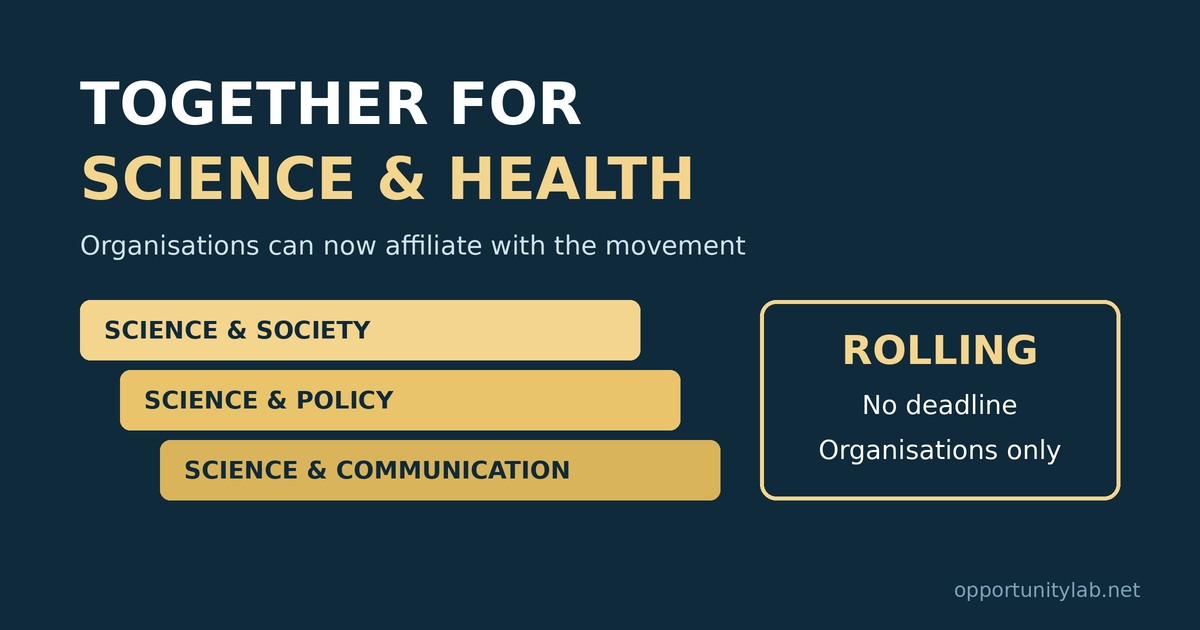

The World Health Organization (WHO) has launched Together for Science and Health, a global movement that brings together scientists, policymakers, practitioners, civil society and communities to rebuild trust in science and make sure evidence guides health decisions. WHO is now inviting organisations that share the movement’s values to affiliate formally. Reports at launch said more than 240 organisations had already joined.
Who this is for: organisations, not individuals. Universities, research institutes, NGOs, professional associations, media and science-communication groups, and health bodies in Africa can all consider joining. There’s no deadline: affiliation is open on a rolling basis.
At a Glance
| Convened by | World Health Organization (WHO) |
| What it is | A global movement to strengthen trust in science and evidence-based health policy |
| Who can join | Organisations and institutions (State and non-State) that share the movement’s values |
| Cost | No fee is mentioned in WHO’s materials |
| Deadline | None. Affiliation is rolling. |
| Contact | [email protected] |
What the Movement Works On
According to WHO’s official leaflet, the movement organises collective action around three areas:
- Science and society: a trustworthy scientific process built on transparency, integrity and rigour, and co-developing research priorities with communities, including the responsible use of new technologies such as AI.
- Science and policy: stronger dialogue with policymakers so that health decisions are timely and grounded in robust data and the lived realities of communities.
- Science and communication: better public dialogue on science, and tackling the harms of misinformation and disinformation so people can engage confidently with health guidance.
The movement’s shared values are summed up as RISES: Respect, Integrity, Scientific rigour, Ethical responsibility and Social inclusion.
Benefits
- Formal affiliation with a WHO-convened global movement
- A platform to propose activities in one or more of the three collaboration areas
- Connections with scientists, policymakers and organisations worldwide working on evidence and trust in health
- Visibility for African institutions’ work on health communication, research uptake and countering misinformation
Note: this is an affiliation, not a grant. WHO’s materials don’t mention funding for members.
Eligibility
- You must apply on behalf of an organisation or institution.
- Your organisation must endorse the movement’s Declaration of Commitment and its values.
- You must confirm adherence to WHO policies, including the rules on using WHO’s visual identity.
- Non-State organisations (NGOs, private-sector bodies, foundations, academic institutions) must confirm compliance with WHO’s Framework of Engagement with Non-State Actors (FENSA), and declare that they are not part of, and don’t support the interests of, the tobacco or arms industries.
How to Apply
WHO describes affiliation as a four-step process, completed through one online form of about 25 questions:
- Organisation details: name, address and other information needed for registration.
- Policy confirmations: agree to WHO’s policies, including FENSA for non-State actors.
- Your contribution: choose the collaboration areas (science and society, science and policy, science and communication) and describe the activities you propose.
- Declaration: sign the declaration of commitment and submit.
Official WHO affiliation form: Together for Science and Health · WHO leaflet (PDF)
Questions: [email protected]
Tips for African Organisations
- Be specific about your contribution. For example, a community health radio programme, a fact-checking desk for health news, or a research-to-policy brief series in your country.
- Have your organisation’s registration details ready, and get sign-off from someone authorised to commit the organisation.
- Read FENSA first if you’re an NGO or private body, so you can answer the compliance questions accurately.