
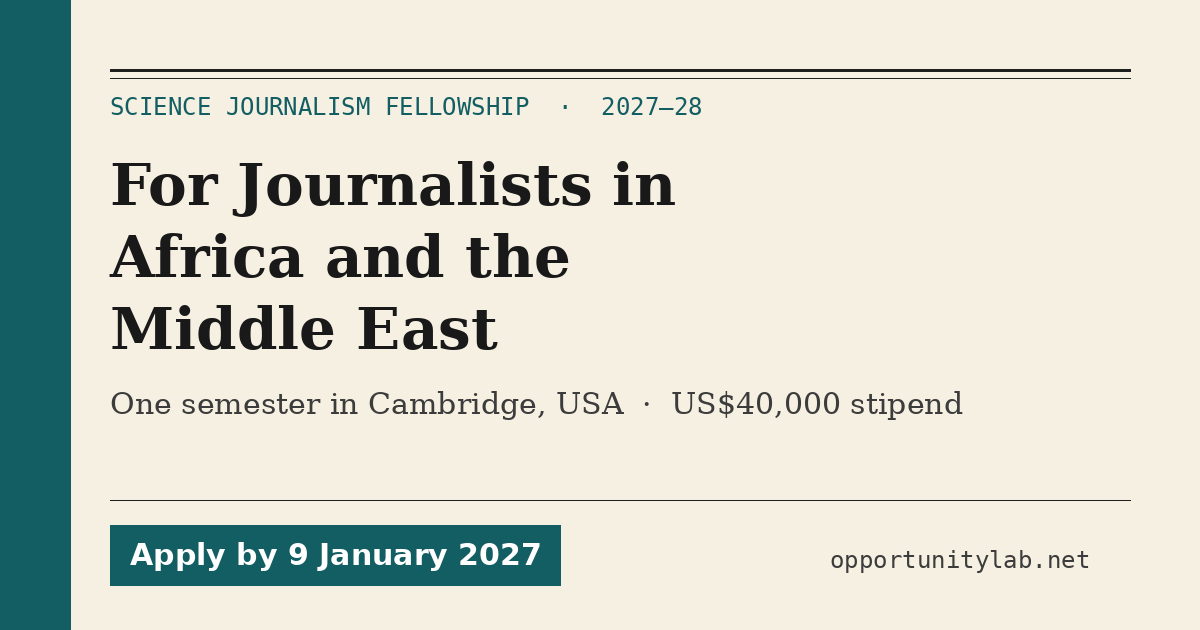
Knight Science Journalism (KSJ) at MIT is accepting applications for its 2027–28 Academic-Year Fellowship. The fellowship gives experienced science, health, technology and environment journalists an academic year at the Massachusetts Institute of Technology in Cambridge, USA, to study, research and grow, with a US$87,500 stipend.
International journalists are encouraged to apply, including journalists from Africa. Applications close on 9 January 2027 at 11:59 pm US Eastern Time.
At a Glance
| Organiser | Knight Science Journalism Program at MIT |
| Location | Cambridge, Massachusetts, USA (in residence) |
| Duration | MIT academic year, mid-August 2027 to May 2028 |
| Stipend | US$87,500 over 9.5 months, plus a US$5,000 travel and housing stipend |
| Open to | Full-time journalists worldwide with 3+ years covering science, health, technology or the environment |
| Deadline | 9 January 2027, 11:59 pm ET |
Eligibility
- You must be a full-time journalist, either on staff or a full-time freelancer. Part-time journalists are not eligible.
- You need at least three consecutive years of covering science, health, technology or the environment.
- Reporters, writers, editors, producers, illustrators, filmmakers, photojournalists and book authors in print, broadcast and digital media can apply.
- Freelancers must list their freelance work from the past 12 months, including each story, outlet and publication or broadcast date.
- You must not have completed a residential fellowship of four months or longer in the two years before applying. Reporting fellowships and grants are fine.
- International applicants are encouraged. Selected fellows need a US visa, usually a J-1 sponsored by MIT (J-2 for dependants). Citizens of countries where the US has suspended visa issuance are asked to wait, unless they can apply with another citizenship.
- Good English is required. MIT checks this through interviews and/or a test such as IELTS or TOEFL. A test is not compulsory but can strengthen your application.
- Your application must be written by you. AI may only be used for minor editing such as spelling and grammar, and you must disclose it.
Benefits
- A stipend of US$87,500, paid over 9.5 months (about US$9,200 a month).
- A US$5,000 travel and housing stipend paid near the start of the fellowship. Fellows pay their own moving costs.
- Health insurance for the fellow and accompanying family members.
- A childcare subsidy of US$500–750 a month for qualifying fellows.
- Free and subsidised public transport, and free or discounted access to museums and other programmes.
How to Apply
Apply online through KSJ’s Submittable form. You will need:
- A statement of purpose (500 words or less)
- A career summary (200 words or less)
- A 30-second video introduction
- Your resume or CV
- A research project proposal (500 words or less)
- Five work samples, with translations for any work not in English
- Three letters of recommendation. You enter your referees’ details and the system sends the requests; make sure letters arrive before the deadline.
Applications are reviewed from January to March. Finalists are invited to video interviews in early March, and the 10 fellows are usually announced in April.
Apply on the official KSJ application form | Official fellowship page
Tip for African journalists: KSJ also runs a separate Fellowship for Advancing Science Journalism in Africa and the Middle East, with the same 9 January 2027 deadline. Check the KSJ fellowships page to see which one suits you.