Important: this competition is only for journalists and content creators based in Djibouti, Ethiopia, Kenya, Somalia, South Sudan, Tanzania or Uganda. Nigerians and other Africans outside these seven countries cannot enter.
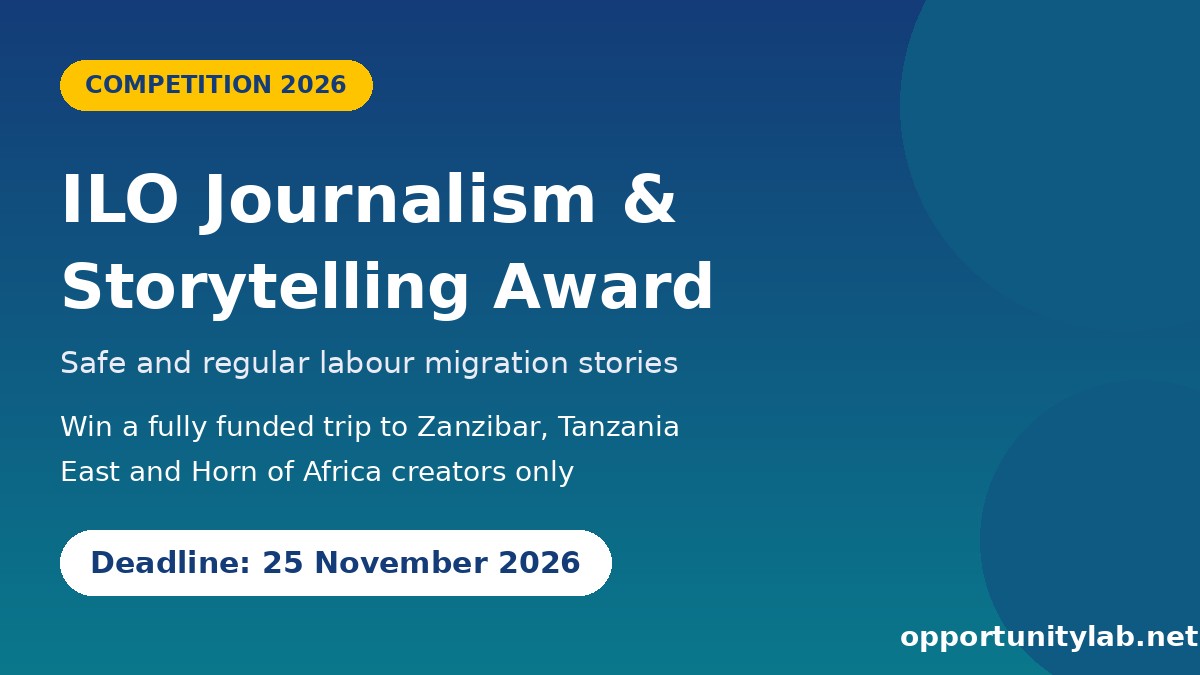
The International Labour Organization (ILO) has opened its BRMM Journalism and Storytelling Competition on Safe, Regular and Orderly Labour Migration. Reporters, photographers, filmmakers and animators can submit a story about labour migration in the East and Horn of Africa. The first-place winner gets a fully funded trip to Zanzibar, Tanzania, to present their work to ministers and senior officials at the Fifth Labour Migration Advisory Group (LMAG) meeting from 16 to 18 December 2026.
Deadline: 25 November 2026, 23:59 East Africa Time (21:59 WAT, 22:59 CAT/SAST).
Key Details
- Organiser: International Labour Organization, through the Better Regional Migration Management (BRMM) Programme funded by the UK Foreign, Commonwealth and Development Office
- Theme: “Safe and regular labour migration: the stories behind the journey”
- Categories: story (print, online or audio), photography, video and animation
- Entries: individuals or teams, up to two entries each
- Language: English, or French with an English summary or subtitles
- How to enter: by email
- Opened: 3 November 2026
- Closes: 25 November 2026, 23:59 EAT
- Winners told: 30 November 2026
Prizes and Benefits
- First place: an invitation to the Fifth LMAG meeting in Zanzibar (16–18 December 2026). The ILO covers travel, accommodation, daily subsistence allowance (DSA) and visa costs. The winner also joins a youth, media and research panel alongside a migrant worker.
- Second place: a plaque and publication of the work on ILO and regional channels.
- Third place: a certificate and publication of the work on ILO channels.
- A chance to present your reporting to policymakers on International Migrants Day (18 December).
- You keep the copyright to your work.
Entry Requirements by Category
- Story: an original article or feature of 800–1,500 words, or an audio piece up to 8 minutes.
- Photography: a photo story of one to five high-resolution images, each with a caption of up to 50 words.
- Video: 8–10 minutes, with English subtitles if not in English.
- Animation: 3–5 minutes, with English subtitles if not in English.
- The work must be original and produced or first published between 1 January 2026 and the closing date.
- Work generated by AI tools will be disqualified; basic editing tools are allowed.
Suggested topics include safe pathways to jobs abroad, the risks of irregular migration and unlicensed recruiters, life as a migrant worker and returning home, how young people decide to migrate, and how migrant workers support their families and economies.
Eligibility
- Journalists, photographers, filmmakers and content creators based in Djibouti, Ethiopia, Kenya, Somalia, South Sudan, Tanzania or Uganda.
- Aged 18 or older on the closing date.
- Teams must name one lead contact; only one team member can travel if the entry wins.
- The first-place winner must hold a valid passport and be able to travel; otherwise the next-ranked entry may be invited.
- ILO staff, consultants, their immediate family and judges cannot enter.
How to Apply
- Read the official ILO call for entries (PDF).
- Prepare your entry, or a link to it, with a short description of up to 150 words.
- Prepare an entry form with your name, organisation (if any), country, category, contact details, a copy of an identity document and a signed statement that the work is original and that people shown gave consent.
- Email both attachments to [email protected] with the subject line “Media Award, Country” (for example, “Media Award, Kenya”).
- Submit before 23:59 EAT on 25 November 2026. Late or incomplete entries will not be considered.
Tips
- Judges score relevance (20), accuracy and evidence (20), storytelling and creativity (25), ethical treatment of people (20) and technical quality (15). Plan your story around these points.
- Use real data and named sources, for example figures from national labour ministries or recruitment agencies.
- Get written consent from anyone you feature, and never identify trafficking survivors or children without it.
- Check that your passport is valid now; there is little time between 30 November and the December trip.
- Avoid sensational images or language; show migrant workers with dignity.