



Important: you cannot apply on your own. Only universities can nominate candidates for this programme, so you must ask your law faculty or university to put your name forward.
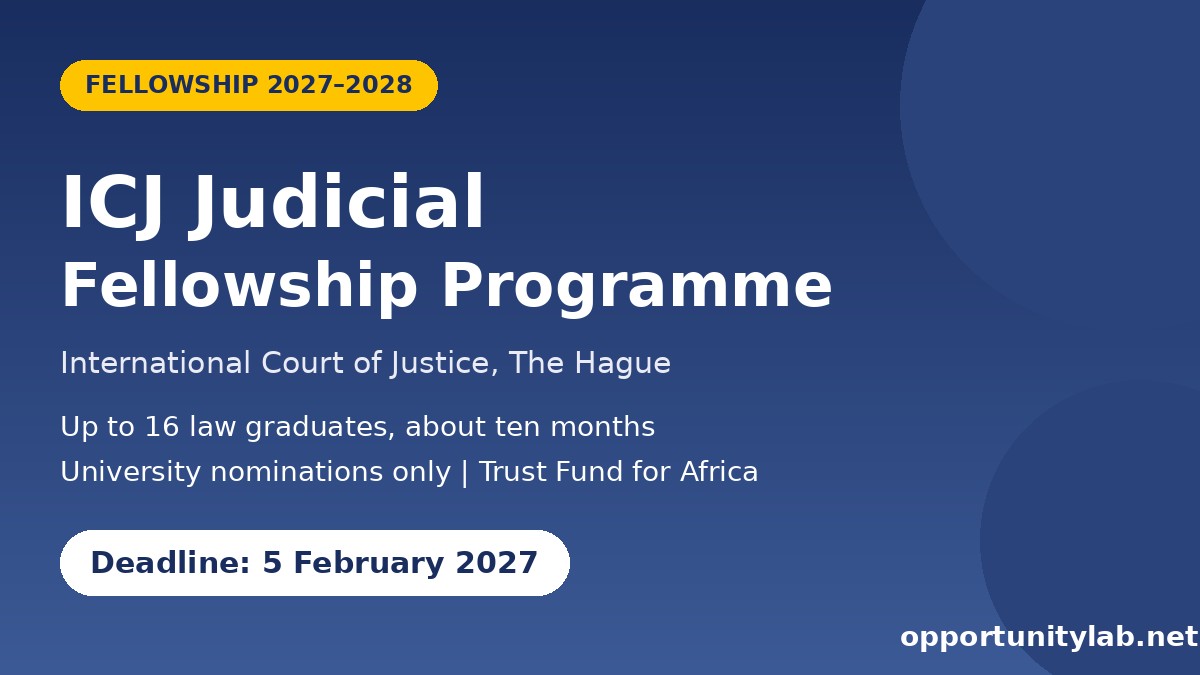
The International Court of Justice (ICJ), the principal judicial organ of the United Nations in The Hague, Netherlands, is accepting nominations for its Judicial Fellowship Programme 2027–2028. Up to 16 recent law graduates will spend about ten months working full-time with a judge of the Court on real cases. For African graduates, the key route is the UN Trust Fund, which pays for fellows nominated by universities in developing countries that cannot afford to sponsor them.
Deadline for university nominations: 5 February 2027 (the official page does not state a time zone). Selection is expected by April 2027.
Key Details
- Host: International Court of Justice, The Hague, Netherlands
- Places: up to 16 fellows a year
- Duration: about ten months, from early September 2027 to June 2028
- Who applies: universities nominate candidates; individual applications are not accepted
- Age limit: generally 31 or younger at the start of the programme
- Languages: English or French
- Nomination deadline: 5 February 2027
- Selection: by April 2027
Benefits
- Full-time work with a Member of the Court, supervised by the judge and their primary legal assistant.
- Legal research and drafting memoranda on pending cases, and attending hearings and sittings.
- Stipend: from this edition, sponsoring universities must pay each fellow at least €3,500 a month (net of taxes and social charges), plus health insurance and travel costs for the whole fellowship.
- Trust Fund awards for nationals of developing countries who graduated recently from a university in a developing country, when their nominating university cannot pay.
- An outstanding entry on the CV of anyone aiming for a career in international law.
The Trust Fund Route for Africans
The UN Secretary-General set up the Trust Fund in April 2021 under General Assembly resolution 75/129 to widen the programme’s geographic and linguistic diversity. It funds fellowships only for candidates nominated by universities in developing countries that cannot sponsor them. Check whether your country and university appear on the ICJ eligibility list (PDF) before approaching your faculty.
Eligibility
- Recent law graduate with excellent academic results.
- Demonstrated interest in public international law through studies, publications or work.
- Excellent spoken and written English or French; working knowledge of the other is an advantage.
- No older than 31 at the start of the programme (exceptions only in special circumstances).
- Nominated by a university. A university may nominate one or more candidates.
How to Apply
- Read the official Judicial Fellowship Programme page and the ICJ FAQs.
- Ask your university (for example, the dean of your law faculty) to nominate you and to appoint a focal point.
- The university completes the ICJ pre-screening and registration form. The focal point then receives the personal history form and candidate profile table by email.
- For each candidate, the focal point emails six documents in this order: nomination letter, ICJ personal history form, reference letters, official academic records, a writing sample and the candidate profile summary table.
- Make sure everything reaches the Court by 5 February 2027.
Tips
- Approach your faculty now; universities need time for internal selection and paperwork before February.
- If your university cannot pay the stipend, ask it to apply under the Trust Fund and point it to the eligibility list.
- Choose a strong writing sample on public international law, such as a dissertation chapter on ECOWAS Court or African Court cases.
- Ask referees who know your international law work well, such as moot court coaches.
- Nigerian law graduates who have completed Law School and NYSC can still qualify if they are within the age limit.