

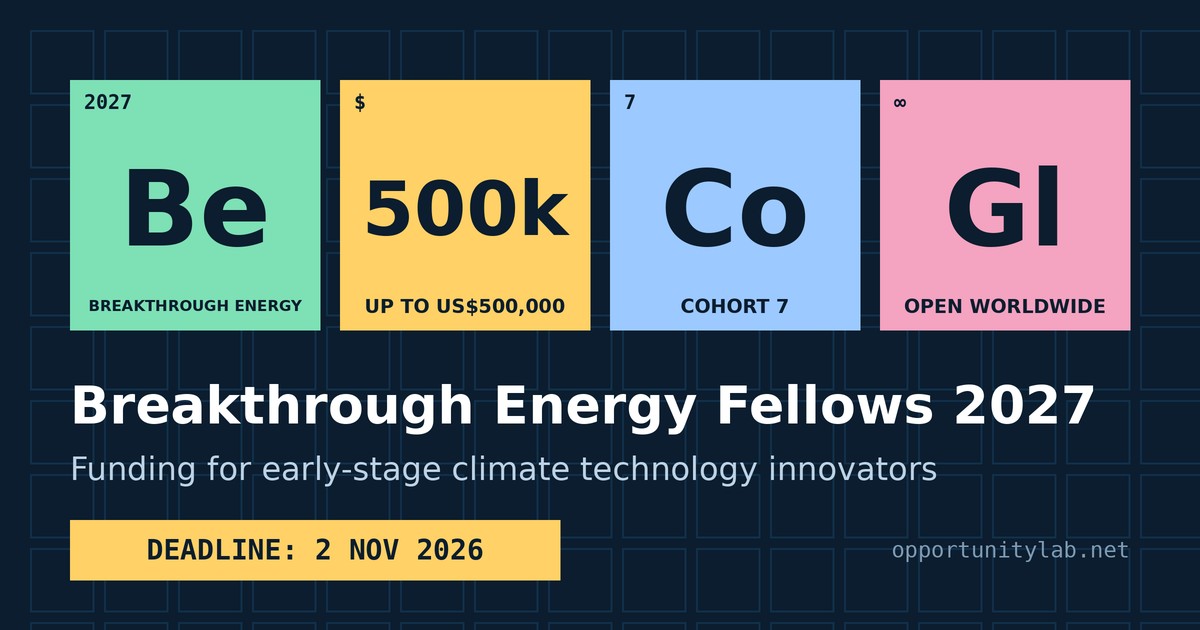
Breakthrough Energy, the climate investment network founded by Bill Gates, is accepting applications for Breakthrough Energy Fellows Cohort 7 (2027). The programme backs scientists, engineers and entrepreneurs with early-stage climate technologies. Innovator Fellows receive up to US$500,000 for research and development, plus mentoring, project management support and access to a global network.
It’s a global programme open to applicants from anywhere, including Africa, and fellows don’t have to relocate. Concept papers for the Innovator Fellowship close on 2 November 2026.
At a Glance
| Organisation | Breakthrough Energy (Breakthrough Energy Discovery) |
| Programme | Breakthrough Energy Fellows, Cohort 7 (2027) |
| Funding | Innovator Fellows: up to US$500,000 (through a SAFE investment) |
| Who can apply | Climate tech innovators worldwide |
| Location | No relocation needed. Some in-person cohort events. |
| Programme start | September 2027 (12 months, plus 3 months of close-out) |
| Deadline | 2 November 2026 (Innovator Fellowship concept papers) |
Three Ways to Join
- Innovator Fellowship (flagship): a full-time, one-year programme for innovators committed to commercialising an early-stage climate technology. This is the track with the 2 November deadline.
- Business Fellowship: a full-time role for experienced business professionals who help Innovators commercialise their technology. Business Fellows get a living stipend and can work from anywhere. They’re recruited as needed.
- Explorers: funding for earlier-stage, higher-risk research, usually led by university or research-lab scientists, who can keep their current jobs. Grants are roughly US$50,000–250,000 (the FAQ also quotes US$50,000–150,000). Explorers are considered on a rolling basis.
Benefits
Innovator Fellows receive:
- Up to US$500,000 for research and development: lab and office space, equipment, supplies, consultants and staff
- Hands-on technology project management from Breakthrough Energy’s experts
- Curriculum and one-to-one mentorship
- Access to a world-class network across business, policy, government, technology and finance
- In-kind support with communications, policy, legal, techno-economics and recruitment
- Help with travel costs for cohort events
Important: the Innovator funding is a SAFE (Simple Agreement for Future Equity), not a grant. In exchange for the funding, Breakthrough Energy may receive shares in your company in a future funding round.
Eligibility
Innovator Fellowship applicants typically:
- have a very early-stage, hard-tech climate technology at technology readiness level (TRL) 1–4
- show the potential to reduce or capture at least 500 million tonnes of greenhouse gases a year at scale, or to meaningfully help with climate adaptation
- have raised less than US$2 million in equity funding (grants don’t count towards this)
- are willing to work on the startup full-time, with no outside job, consulting or study
- can incorporate a company before September 2027. You don’t need a company to apply.
Who it suits: many Innovator Fellows have PhDs. The programme looks for step-change technologies rather than incremental improvements. All communication and training is in English.
How to Apply
- Register on the official Breakthrough Energy Fellows application portal (link below).
- Submit a Concept Paper with preliminary information by 2 November 2026.
- If selected, submit a Full Application.
- Shortlisted applicants are invited to a Deep-Dive interview.
- Fellows are selected around mid-2027, and Cohort 7 starts in September 2027.
Apply on the official Breakthrough Energy Fellows portal · Official FAQ
Beware of scams: Breakthrough Energy says it never asks for payment by cash, gift cards, wire transfer or cryptocurrency, and doesn’t do official business on social media. Its official emails come from breakthroughenergy.org or befellows.org.
Tips for African Applicants
- Show the scale. Explain clearly how your technology could cut or capture emissions at the 500-million-tonne scale, or how it helps communities adapt to climate change.
- Keep the concept paper sharp. It’s the first filter, so focus on the problem, your technical approach, your evidence so far and what you’d achieve in 12 months.
- Plan your company. Think about where you’ll incorporate before September 2027.
- Researchers in universities who can’t commit full-time should look at the Explorer track instead.