



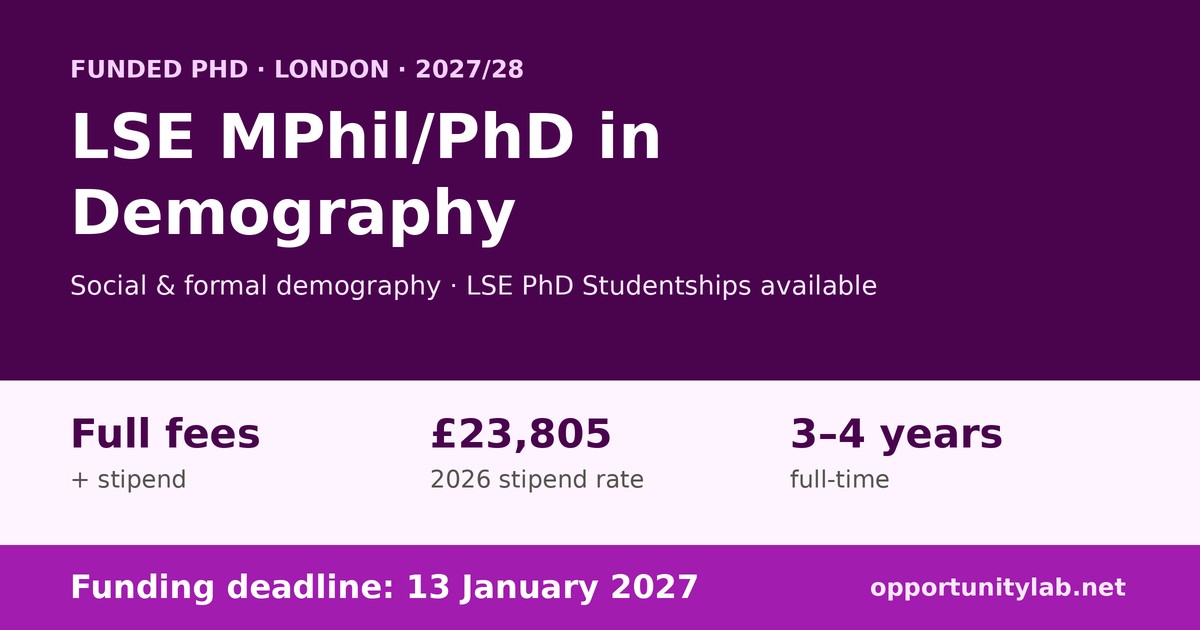
Interested in how populations change: births, deaths, migration, ageing, families and health? The London School of Economics and Political Science (LSE) is accepting applications for its MPhil/PhD in Demography (Social/Formal) for 2027/28. International students can compete for LSE PhD Studentships, which cover full fees plus a living stipend. To be considered for funding, apply by 13 January 2027. The final application deadline is 27 May 2027.
Programme at a Glance
- University: London School of Economics and Political Science (LSE), London, UK
- Department: Department of Methodology
- Degree: MPhil/PhD in Demography, with two streams: social demography and formal demography
- Start: 27 September 2027
- Length: Usually 3–4 years full-time
- Fees (first year, 2027/28): Home £5,368; Overseas £25,300
- Funding: LSE PhD Studentships and ESRC studentships (competitive)
- Funding deadline: 13 January 2027
- Final application deadline: 27 May 2027
About the Programme
Demography is the study of human populations over time. LSE’s programme offers two routes:
- Social demography looks at the social, cultural and economic causes and effects of population change, such as fertility, family formation, migration and inequality.
- Formal demography focuses on the statistical measurement and modelling of population dynamics, such as mortality, life expectancy and population projections.
Africa is the world’s fastest-growing region, so demographic research skills are in high demand in governments, universities, the UN and development organisations. That makes this PhD especially relevant for African researchers.
Funding and Benefits
- LSE PhD Studentships: cover full tuition fees plus an annual stipend, and are open to home and international students. For 2026 entry the stipend was £23,805 a year. LSE hadn’t confirmed the 2027 figure at the time of writing.
- ESRC studentships: UK research council funding. Most of it goes to home students, with limited places for international candidates.
- Other LSE awards: scholarships for students from specific world regions and for certain subjects
- Training at a world-leading social science university, in the heart of London
Important: to be considered for LSE PhD Studentships or ESRC funding, your complete application must be in by 13 January 2027. Applications after that date, up to 27 May, are only considered for admission, not funding.
Eligibility
- A bachelor’s degree with upper second-class honours (2:1) or equivalent
- A master’s degree with a high merit (65% or above), preferably in a relevant social science, with a dissertation mark of 65% or above
- Meet LSE’s English language requirements (research level)
- A strong, feasible research proposal in demography
Required Documents
- Academic transcripts and certificates
- A statement of academic purpose
- References
- A CV
- A research proposal
- A sample of written work
- Proof of English proficiency, if required
Tips for a Strong Application
- Apply by 13 January. Applying later rules you out of the main funding.
- Write a focused research proposal. State your research question, data sources (such as DHS surveys, censuses or vital registration) and methods, and say how you’d handle data problems.
- Choose your stream deliberately. Strong quantitative skills suit formal demography. Interests in society and policy suit social demography.
- Show quantitative training. Mention statistics, R, Stata or Python, and any survey analysis.
- Read LSE staff research and mention potential supervisors whose work matches yours.
- Get strong academic references from people who know your research ability.
How to Apply
- Read the programme page and the “Your application” guidance on LSE’s website.
- Prepare your research proposal, statement, CV, writing sample and references.
- Apply online through LSE’s graduate application system.
- Submit everything by 13 January 2027 for funding, or by 27 May 2027 at the latest.
Read the official LSE MPhil/PhD Demography page and apply