






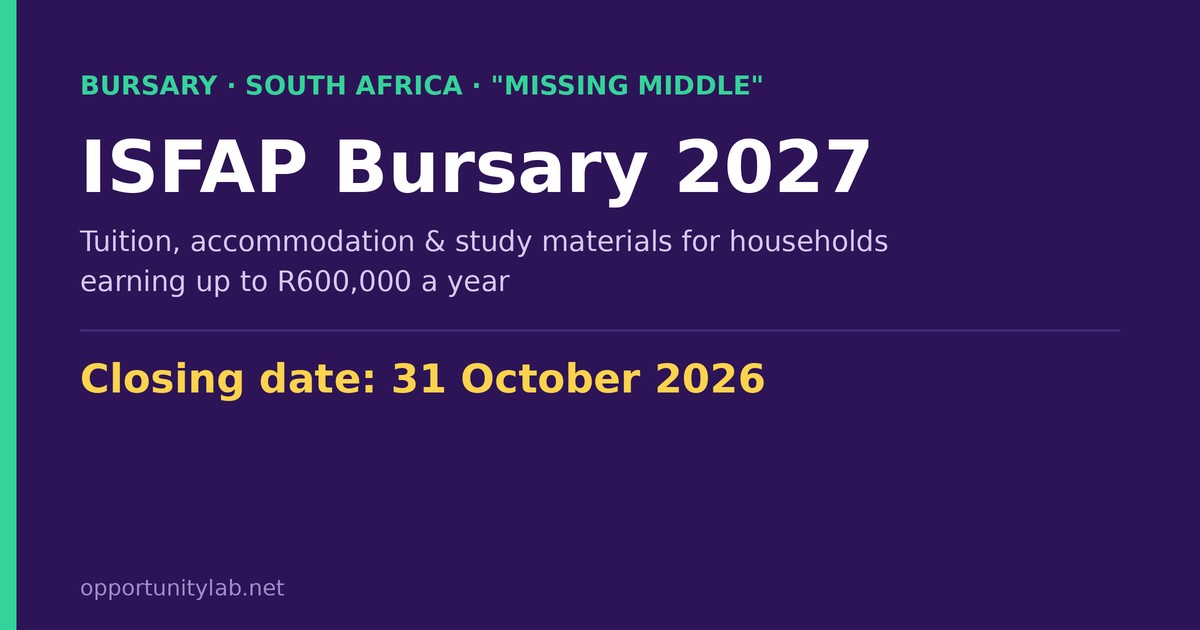
Does your family earn too much to qualify for NSFAS, but not enough to pay for university? You may fall into the “missing middle”, and that is exactly who the Ikusasa Student Financial Aid Programme (ISFAP) is designed for. ISFAP has opened applications for its 2027 bursary, which can cover tuition, accommodation, study materials and more for students at approved South African public universities. Applications close on 31 October 2026.
Bursary at a Glance
- Funder: Ikusasa Student Financial Aid Programme (ISFAP)
- For: South African students from “missing middle” households
- Household income: Generally up to R600,000 per year (thresholds can differ by funding category)
- Study level: Undergraduate studies at approved public universities
- Academic year: 2027
- Application: Online
- Closing date: 31 October 2026
What Is the “Missing Middle”?
NSFAS mainly funds students from households earning R350,000 a year or less. Many families earn more than that, yet still can’t afford university fees and living costs. These students are often called the “missing middle”. ISFAP was set up to close that gap, using funding from partners to support capable students in fields where South Africa needs more skilled graduates.
Note: ISFAP is not a replacement for NSFAS. If your household earns under the NSFAS threshold, you should also apply to NSFAS.
Benefits
ISFAP offers a comprehensive funding package. Depending on your package, it can cover:
- Tuition fees
- Accommodation
- Meals, where included
- Books and study materials
- Transport, where applicable
- A monthly allowance, depending on the package
ISFAP also supports students beyond the money, with academic support, mentoring and wellness services to help them pass and graduate.
Eligibility
You may qualify if you:
- Are a South African citizen
- Come from a household with a combined income within ISFAP’s threshold (generally up to R600,000 a year)
- Are currently in Matric or have completed Matric
- Have applied to, or been accepted at, an ISFAP partner public university
- Plan to study a qualification that ISFAP supports
- Meet the academic and admission requirements for your chosen course
Supported Fields of Study
ISFAP funds study in priority fields where South Africa has skills shortages. These typically include:
- Engineering
- Computer science and information technology
- Health sciences
- Accounting and other approved commerce disciplines
The exact qualifications and partner universities vary each year, so check what is available for 2027 on the ISFAP application portal before you apply.
Required Documents
All copies must be certified within the last three months:
- A certified copy of your ID
- Matric learners: your Grade 11 final results and latest Matric results
- Matric completed: your final Matric results or certificate
- The ISFAP Funding Application Consent Form, signed by you and all household contributors
- Proof of household income:
- recent payslips for employed household members
- affidavits for unemployed household members
- proof of any grants or pensions
- Certified IDs of your parents, guardians and other household contributors
Tips for a Successful Application
- Start with the consent form. Every household contributor must sign it, which can take time if family members live apart.
- Check that your course is covered. Make sure both your university and your qualification are on ISFAP’s approved list for 2027.
- Apply to university too. ISFAP funding depends on your admission to an approved university, so don’t miss university application deadlines.
- Submit early. Funding is limited, and complete applications submitted well before the deadline have the best chance.
- Have a backup. Applying for other bursaries and NSFAS (if eligible) improves your chances of being funded.
How to Apply
- Register for an account on the ISFAP online application portal.
- Complete the application form and choose your university and qualification.
- Upload all certified documents and the signed consent form.
- Submit before 31 October 2026.
Visit the official ISFAP website to apply
Applying is free. Never pay anyone who offers to “guarantee” ISFAP funding.