



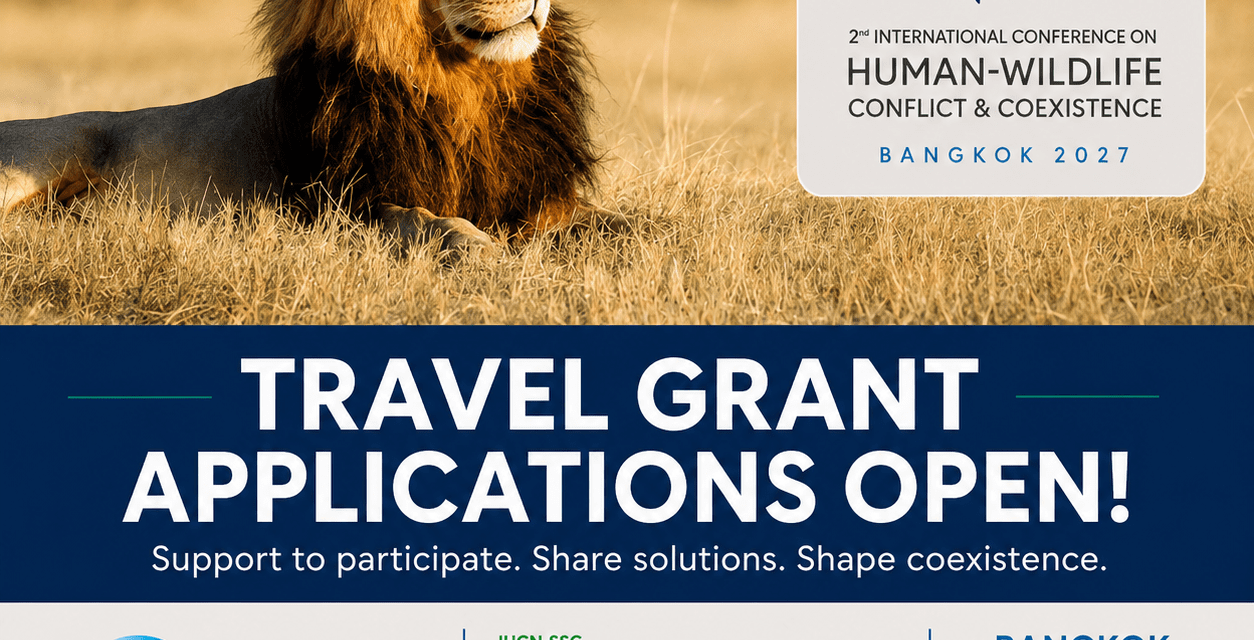
The 2nd International Conference on Human-Wildlife Conflict and Coexistence will take place in Bangkok, Thailand, in March 2027. To help more people attend, the organisers now offer a limited number of travel grants. These grants support registration fees and travel costs for eligible applicants. If you want to join this important event but worry about costs, this opportunity may help you.
Who Is Eligible for Human-Wildlife Conflict Conference Travel Grants?
You do not need to register for the conference before you apply. However, the review team gives priority to certain groups. You have a stronger chance if you meet at least one of these conditions:
- You live in a country that the World Bank does not classify as high-income.
- You are a student, no matter which country you come from.
- You have submitted an abstract for a talk, poster, or session at the conference, or you take part in a session that someone else submitted.
In other words, the organisers want to support people who might otherwise struggle to attend because of financial barriers or early-career status.
What Countries or Regions Qualify for the Travel Grants?
The conference welcomes applicants from all countries. Nevertheless, priority goes to applicants who reside in countries not classified as high-income by the World Bank. This includes many nations across Africa, Asia, Latin America, and the Pacific.
Students from any country can also apply, even if they study in a high-income country. Therefore, your current country of residence and your student status both matter.
What Do the Human-Wildlife Conflict Conference Travel Grants Cover?
The programme offers two main types of support. You may apply for only one of them.
1) Conference Registration Support
If you receive this grant, the organisers will either:
- Waive your registration fee, so you do not pay at all, or
- Reimburse your registration fee if you have already paid.
After they approve your application, they will send you a form to register and confirm your place.
2) Travel Cost Support
If you receive travel funding, you will get cash support in person at the conference in Bangkok on 3 March 2027. The award will be either:
- US$500, or
- US$1,000.
Your award letter will confirm the exact amount and how you will receive it.
Are There Academic Requirements for the Travel Grants?
The organisers do not list strict academic requirements such as a minimum GPA or degree level. Instead, they focus on your connection to the conference theme and your need for support.
However, you strengthen your application if you:
- Study or work in fields related to conservation, ecology, wildlife management, rural livelihoods, or human-wildlife conflict.
- Plan to present an abstract, poster, or session at the conference.
- Show how attending will help your studies, research, or community work.
Consequently, early-career researchers, graduate students, and practitioners with relevant experience often fit well.
What Documents Do You Need to Apply?
The application uses an online form in English. The conference page does not require you to upload many documents at the application stage. However, you should prepare the following information before you start:
- Your full name and contact details.
- Your country of residence and institution (if you are a student).
- A short explanation of why you want to attend the conference.
- Details about any abstract, poster, or session you have submitted (if applicable).
- Your estimated travel costs and financial need.
Later, if you win a grant, the organisers may ask for proof of registration, student status, or travel plans. Therefore, keep your documents ready.
When Is the Deadline for Human-Wildlife Conflict Conference Travel Grants?
You must submit your application in English using the official online form. The deadline is firm.
- Application deadline: 23:59 GMT on 31 October 2026
- Notification date: By 15 November 2026
Funding is limited, so an application does not guarantee support. The review team will assess all submissions against the eligibility criteria and the available budget.
Therefore, you should prepare your answers carefully and submit before the deadline. Do not wait until the last day, because technical issues could delay your submission.
How Do You Apply for the Travel Grants?
Follow these simple steps:
- Visit the official conference travel grants page.
- Read the eligibility criteria and grant types carefully.
- Click the “Apply here” link to open the online form.
- Complete all fields in English.
- Review your answers for clarity and accuracy.
- Submit the form before 23:59 GMT on 31 October 2026.
After you submit, you will receive a confirmation. Then, wait for the decision by 15 November 2026.
What Are the Benefits of the Human-Wildlife Conflict Conference Travel Grants?
Winning a travel grant brings several clear benefits:
- Lower costs: You either pay no registration fee or receive up to US$1,000 towards travel.
- Global exposure: You can present your work, learn from experts, and join international discussions on human-wildlife conflict.
- Networking: You meet researchers, practitioners, and policymakers from around the world.
- Career growth: Conference participation can strengthen your profile for scholarships, fellowships, jobs, and collaborations.
- Knowledge sharing: You bring new ideas and tools back to your institution or community.
Moreover, attending in person allows you to build stronger relationships than online participation alone.
If you want more help finding and applying for global opportunities, visit OpportunityLab for verified listings, application guides, and deadline alerts tailored to African applicants
Why This Opportunity Matters for African Applicants
Many African students and early-career professionals want to attend international conferences but face high travel and registration costs. Travel grants like these reduce that barrier. They also help researchers share African perspectives on human-wildlife conflict, conservation, and coexistence.
This travel grant programme offers a realistic path for students and applicants from non-high-income countries to join the 2nd International Conference on Human-Wildlife Conflict and Coexistence. The funding is limited, but it can make a big difference for those who receive it.