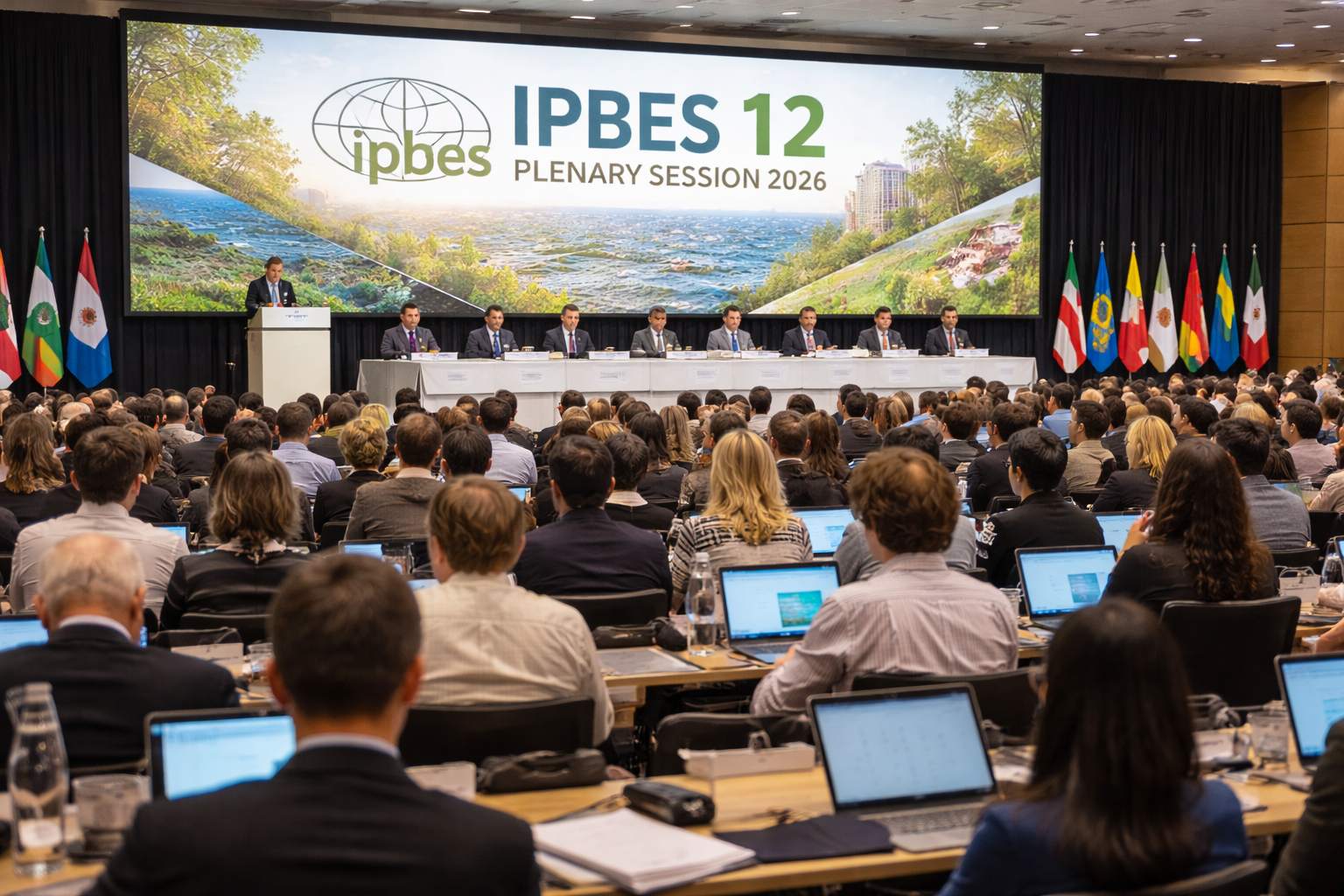
The IPBES 12 Plenary Session 2026 will take place from 3 to 8 February 2026 in Manchester, United Kingdom. This high-level gathering brings together governments, scientists, biodiversity experts, and policymakers to advance global environmental governance.
Organized under the framework of the Intergovernmental Science-Policy Platform on Biodiversity and Ecosystem Services, the plenary session plays a critical role in shaping international biodiversity strategy.
About IPBES
The Intergovernmental Science-Policy Platform on Biodiversity and Ecosystem Services serves as the leading global science-policy body dedicated to biodiversity and ecosystem services.
Often described as the “IPCC for biodiversity,” IPBES strengthens the interface between science and policy. Consequently, it supports evidence-based decision-making worldwide.
The platform operates in collaboration with:
- United Nations Environment Programme
- UNESCO
- Food and Agriculture Organization
- United Nations Development Programme
Therefore, its plenary sessions carry significant diplomatic and environmental weight.
Key Highlights of IPBES 12
1. Business and Biodiversity Assessment Launch
One of the most anticipated outcomes of the IPBES 12 Plenary Session 2026 is the release of the Business and Biodiversity Assessment.
This landmark report examines:
- Corporate dependency on biodiversity
- Economic risks linked to ecosystem degradation
- Policy options for private-sector accountability
As a result, governments and industries will gain new evidence to inform sustainable business practices.
2. High-Level Political Engagement
The opening ceremony included a message from His Majesty King Charles III, delivered by the UK Secretary of State for Environment, Food and Rural Affairs.
Such engagement signals growing political recognition of biodiversity loss as a systemic global risk.
3. Membership Expansion
The Republic of Slovenia officially joined IPBES as a member ahead of the session. Therefore, the platform continues to expand its global representation and influence.

Why IPBES 12 Matters
The IPBES 12 Plenary Session 2026 takes place at a critical moment for biodiversity governance.
Currently, nations are working toward the 2050 Vision for Biodiversity. However, accelerating species loss, ecosystem collapse, and climate-related pressures require coordinated international action.
IPBES assessments including thematic, regional, and global reports provide governments with actionable scientific knowledge. Consequently, policy frameworks increasingly rely on its findings.
Broader IPBES Work Programme
Beyond the plenary, IPBES continues to advance:
- Spatial planning and ecological connectivity assessments
- Second global biodiversity assessment chapters
- External expert reviews
- Capacity-building initiatives
- Knowledge foundation strengthening
Therefore, IPBES 12 functions both as a decision-making forum and as a milestone within a larger multi-year work programme.
Who Should Follow IPBES 12?
This plenary session holds particular relevance for:
- Environmental policymakers
- Biodiversity researchers
- Climate negotiators
- Sustainable finance leaders
- Corporate ESG strategists
- International development institutions
Because biodiversity risk increasingly intersects with economic stability, IPBES findings now influence multiple sectors.
The IPBES 12 Plenary Session 2026 represents more than an annual meeting. Instead, it reinforces the global science-policy architecture necessary to address biodiversity loss at scale.
As governments, experts, and institutions convene in Manchester, the outcomes of this session will shape environmental governance for years to come.
For policymakers, researchers, and sustainability leaders, closely monitoring IPBES developments remains essential.