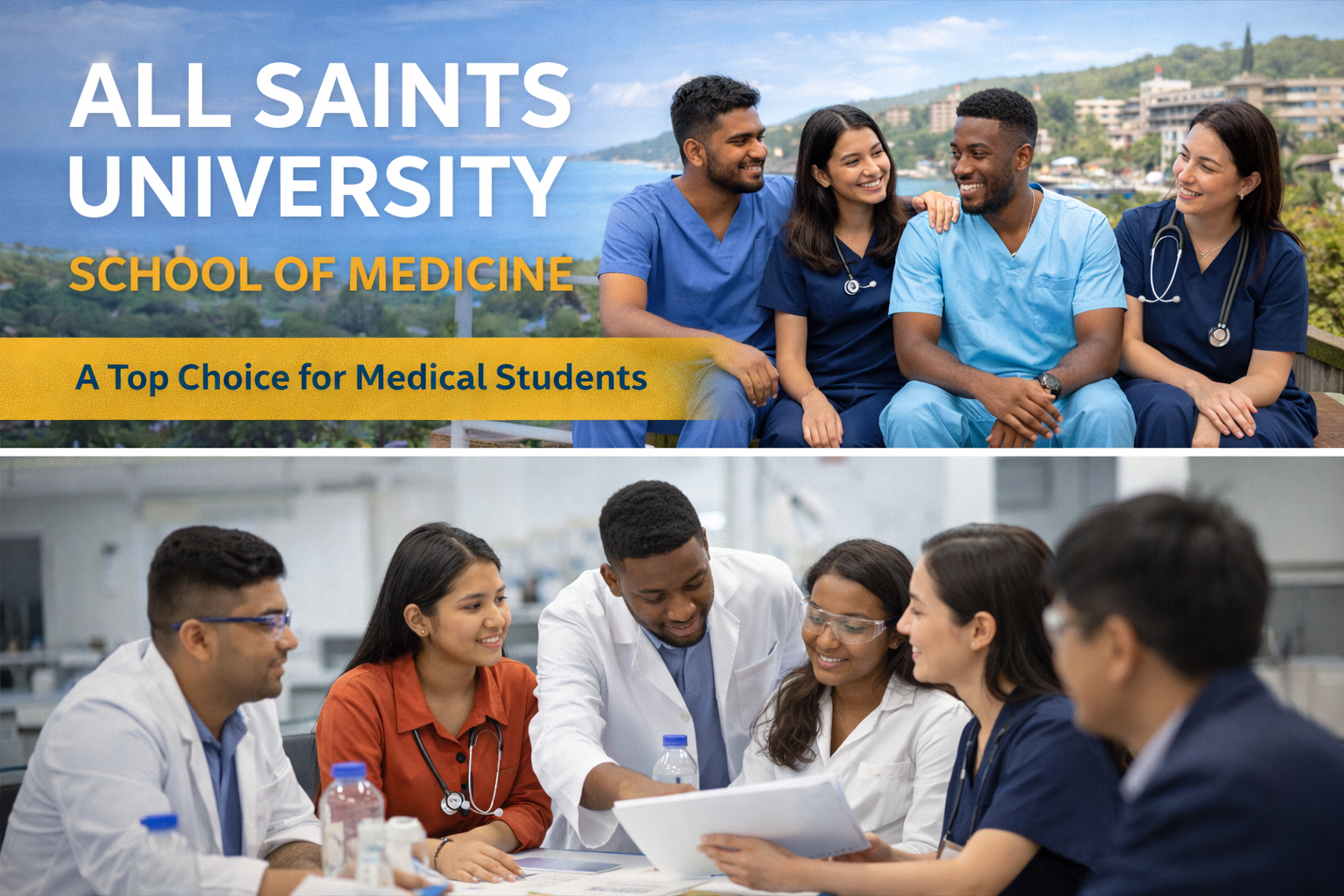
If you are searching for a reputable Caribbean medical school, then All Saints University School of Medicine deserves serious consideration. Located in the Caribbean, this institution has steadily built a reputation for providing quality medical education, strong clinical training, and affordable tuition options.
Many aspiring doctors choose All Saints University School of Medicine because it combines academic rigor with personalized support. Moreover, the university focuses on preparing students for licensure exams and successful medical careers in the United States, Canada, and beyond.
In addition to its strong curriculum, All Saints University College of Medicine (a commonly used synonym) emphasizes small class sizes and hands-on learning. As a result, students benefit from closer interaction with faculty and better academic guidance.
Why Choose All Saints University School of Medicine?
Choosing a medical school represents one of the most important decisions in a future doctor’s life. Therefore, students must evaluate accreditation, curriculum quality, clinical rotations, and graduate outcomes carefully.
Accredited and Recognized Medical Institution
All Saints University School of Medicine operates as an accredited Caribbean medical university. Importantly, accreditation ensures that the institution meets established academic and professional standards.
Furthermore, graduates from this Caribbean medical school become eligible to sit for major licensing examinations such as the USMLE, depending on regulatory requirements in their destination country.
Because recognition plays a key role in postgraduate opportunities, students should always verify eligibility requirements for their preferred medical licensing boards.
Affordable Tuition Compared to Other Medical Schools
 Medical education can be expensive, especially in North America. However, All Saints University School of Medicine offers comparatively affordable tuition.
Consequently, many international students find it a practical alternative to U.S. or Canadian medical schools. In addition, flexible payment structures make financial planning more manageable.
Academic Programs at All Saints University School of Medicine
The university provides a Doctor of Medicine (MD) program designed to meet global medical education standards.
Pre-Medical Program
Students who do not yet meet direct MD entry requirements may enroll in the pre-medical pathway. This foundational program strengthens knowledge in:
- Biology
- Chemistry
- Physics
- Basic medical sciences
Therefore, students build the academic foundation required for success in medical studies.
Doctor of Medicine (MD) Program
The MD program at All Saints University College of Medicine follows a structured curriculum divided into:
- Basic Sciences (Pre-Clinical Years)
- Clinical Sciences (Clinical Rotations)
During the pre-clinical phase, students study anatomy, physiology, pathology, pharmacology, and other essential subjects.
Subsequently, students transition into clinical rotations in affiliated hospitals. This hands-on training allows them to apply theoretical knowledge in real-world healthcare settings.
Because clinical exposure shapes future medical competence, this stage plays a critical role in preparing students for licensure examinations.
Admission Requirements
Admission into All Saints University School of Medicine remains competitive but accessible to qualified candidates.
General Entry Requirements
Applicants typically must provide:
- High school diploma or bachelor’s degree
- Academic transcripts
- Personal statement
- Letters of recommendation
- English proficiency (if applicable)
Moreover, the admissions team evaluates applicants holistically. Therefore, leadership experience, healthcare exposure, and community service can strengthen applications.
Clinical Rotations and Career Prospects
Clinical rotations represent one of the most important components of medical training. Fortunately, All Saints University School of Medicine collaborates with teaching hospitals to provide structured clinical experiences.
Through these rotations, students gain exposure to:
- Internal Medicine
- Surgery
- Pediatrics
- Obstetrics and Gynecology
- Psychiatry
As a result, graduates develop both competence and confidence.
Furthermore, many graduates pursue residency placements in the United States and other countries, depending on exam performance and licensing requirements.
Student Support and Learning Environment
Unlike larger institutions where students may feel overlooked, All Saints University School of Medicine maintains smaller class sizes. Consequently, faculty members can offer personalized mentorship.
Additionally, the university promotes:
- Academic advising
- Exam preparation support
- Peer learning initiatives
Because medical school can be demanding, supportive learning environments significantly improve student outcomes.
Ultimately, All Saints University School of Medicine provides a strong pathway for students who aspire to become doctors but seek an alternative to traditional North American institutions.
With affordable tuition, structured clinical training, and global recognition opportunities, this Caribbean medical university continues to attract students from around the world.
Before applying, however, prospective students should carefully review accreditation details and licensing eligibility in their target country. Making informed decisions ensures long-term professional success.